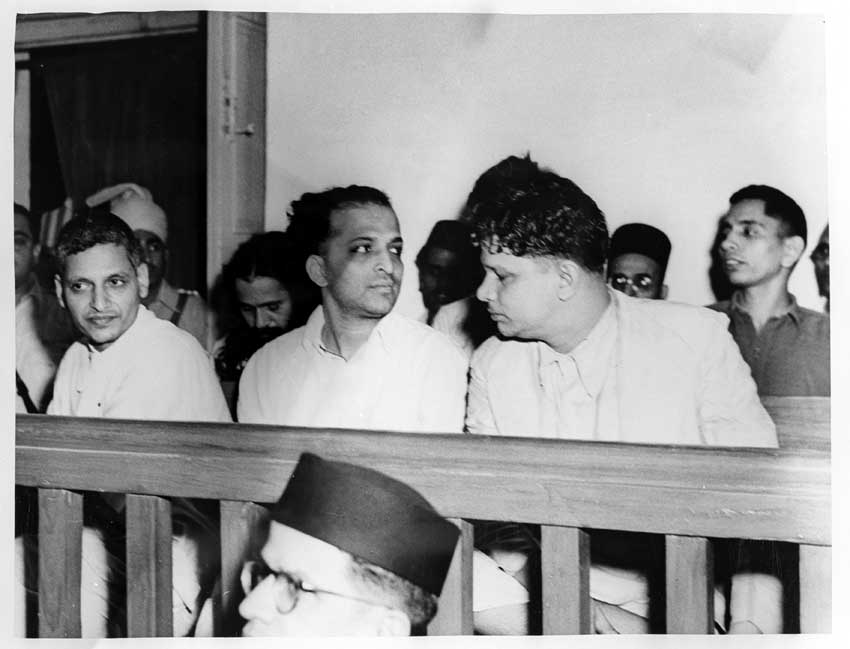
Inside India #34: The Ghosts of Partition

This article is one of a series of 50. Together they explore the history and culture of India from her most ancient civilisations to the nation’s ambitious space programme. All 50 articles will be collected into a digital book and published in due course. To receive a FREE copy of the book, simply register for my newsletter here.

We often think of the Partition of India in 1947 as a macro-level historical event involving nation states and major world figures. But the truth is that Partition had – and continues to have – an enduring effect on individual lives. Millions died, millions more lost their homes, their businesses, the lives they had known.

So what exactly happened?

Picture attribution: Technark-1, CC BY-SA 3.0

In 1947, the Indian struggle for independence culminated with the departure of the British following a three-hundred-year presence on the subcontinent, the last ninety of which is remembered as the colonial era known as the Raj. Lacking the resources to continue occupying a nation of 300 million that, led by lawyer-turned-statesman Mohandas Gandhi, had turned non-cooperation into a revolutionary weapon, the British departed in a hurry, practically running out the door, with little regard to the mess they were leaving behind.

That mess was Partition.

Following agitation by the All-India Muslim League for a separate Muslim state, and communal riots that wracked the country, the British had agreed a Partition Plan and then, in a matter of months, slashed the country into three parts: Muslim-majority Pakistan and East Pakistan (later to become Bangladesh), and Hindu-majority India.

There followed mass migrations between these states – migrations accompanied by murder on a colossal scale.

In a June 2015 New Yorker article, historian William Dalrymple tells us: “Across the Indian subcontinent, communities that had coexisted for almost a millennium attacked each other in a terrifying outbreak of sectarian violence, with Hindus and Sikhs on one side and Muslims on the other—a mutual genocide as unexpected as it was unprecedented.”

The violence was particularly intense in the states of Punjab in the West and Bengal in the East, both of which, Dalrymple goes on to state, witnessed: “massacres, arson, forced conversions, mass abductions, and savage sexual violence.”

By the time the dust had settled in 1948, fifteen million were displaced, and anywhere from one to two million lay dead.

What was particularly horrendous was how individual communities that had lived together peacefully for decades – if not centuries – suddenly hurled themselves at each other’s throats in a murderous frenzy.

Why did this happen?

Muslims and Hindus had co-existed on the subcontinent for at least a thousand years since the arrival of Turkish and Arab traders and, later, invaders. That millennia saw a constant back and forth between Hindu and Muslim rulers across the vastness of the subcontinent, culminating in the Mughal empire which, with the exception of the markedly intolerant reign of Emperor Aurangazeb, was largely characterised by relative stability interspersed with bouts of military conflict.

With the coming of the British, Hindus, Muslims and Sikhs found themselves thrown together in common cause against a mutual enemy. During the early years of the Independence struggle an unprecedented communal harmony rallied behind the likes of Gandhi, Jawaharlal Nehru, and Mohammed Ali Jinnah, the three men at the heart of India’s leading Congress Party.

But once these three political titans fell out, the path to divergence became inevitable.

Jinnah, once a strong supporter of Muslim-Hindu unity, eventually came to believe that a separate nation was the only solution to preventing Hindu dominance in the post-colonial India. He became the leader of the Muslim League and the country’s most vocal proponent of Partition.

Things came to a head when the political rhetoric turned to violence on the streets of Calcutta in August 1946. The so-called Direct Action Day riots led to five thousand dead in a paroxysm of savagery that shocked the British, reduced to the status of ineffectual referees.

In March 1947, Lord Louis Mountbatten, Britain’s final Viceroy to India, arrived to sort out the mess. A few months later, unable to find consensus among the political factionalism, he shocked everyone by announcing that the British would transfer power on 15 August of that same year – well ahead of schedule – and that Partition would become a reality.

As Muslims, Hindus and Sikhs began to move between territories – both before and after Independence – the violence spiralled out of control. Villages were set alight, trains were attacked and their passengers murdered wholesale, refugees were waylaid and cut down by sword, scythe, and a savagery that later led Bombay-based writer Saadat Hasan Manto to lament that “human beings in both countries were slaves, slaves of bigotry . . . slaves of religious passions, slaves of animal instincts and barbarity.”

The chaos of Partition cannot be blamed solely on Mountbatten and British policy or even on the machinations of subcontinental politicians. Ordinary citizens must shoulder their share of the blame, those who allowed themselves to be incited into hatred and religious xenophobia, who set aside decency and longstanding neighbourliness, who took up sword and flame to terrorise their compatriots, to murder men, women, and children in a frenzy of bloodlust that even now is difficult to comprehend.

A generation of older Indians and Pakistanis who remember those times understand the hateful rhetoric that today pits the two neighbours against one another at regular intervals.

That is the true legacy of Partition. The way it has coloured the perceptions of two peoples who were essentially one, the way it continues to serve as a means by which political interests on both sides of the border can employ hatred and prejudice as a means of deflecting criticism of their regimes.

One can only hope that the wounds of history are healed in the fullness of time. Only then might the ghosts of Partition, the millions of dead and missing, find peace.

My latest novel, The Dying Day, is set in India, in the 1950s, and features India’s first female police detective, Persis Wadia, as she investigates the disappearance of one of the world’s great treasures, a 600-year-old copy of Dante’s The Divine Comedy stored at Bombay’s Asiatic Society. Soon bodies begin to pile up… Available from bookshops big and small and online. To see buying options please click here.  

This article is one of a series of 50 that I will be publishing on my website. Together these pieces explore the history and culture of India from her most ancient civilisations to the nation’s ambitious space programme. You can read all 50 pieces here.

All 50 articles will be collected into a digital book and published in due course. To receive a FREE copy of the book, simply register for my newsletter here. The newsletter goes out every three months and contains updates on book releases, articles, competitions, giveaways, and lots of other interesting stuff. 
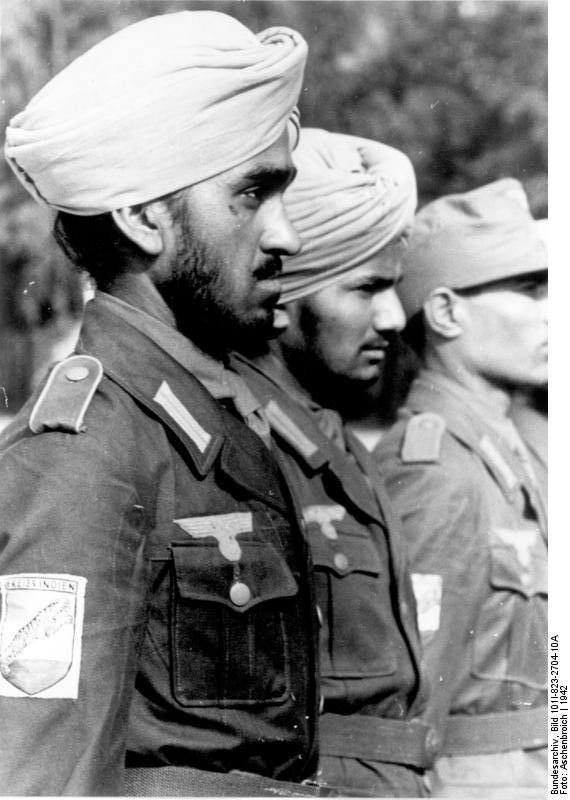
Inside India #33: India’s Tiger Legion – when Indian soldiers fought in the German army

This article is one of a series of 50. Together they explore the history and culture of India from her most ancient civilisations to the nation’s ambitious space programme. All 50 articles will be collected into a digital book and published in due course. To receive a FREE copy of the book, simply register for my newsletter here.

3 April 1941. Indian revolutionary leader, Subhas Chandra Bose, arrives in Berlin.

Bose, a native of Bengal and former President of the Indian National Congress (the party of Gandhi and Nehru), is already high on the list of those causing heartburn for the martinets of the British Raj.

Arrested numerous times for ‘anti-Imperialist’ activities, Bose had fled the subcontinent to Germany in order to enlist the German army’s help in ousting the British from India. Operating by the old adage ‘my enemy’s enemy is my friend’, Bose, managed to convince the German foreign ministry to recognise his provisional ‘Free India Government’ in exile, and to help him raise a force to fight his cause. That army was to be called the ‘Free India Legion’ – later known simply as the Indian Legion or, more colourfully, the Tiger Legion.

Picture attribution: Aschenbroich CC 3.0

Bose’s plan was to lead an invasion of British India, once his legion had been suitably armed by his hosts.

But where did the Bengali leader find fighting men willing to serve under a German flag?

Bose began by recruiting Indian students living in Germany at the time. Next, he toured POW camps in the country, home to thousands of Indian soldiers captured by Rommel in North Africa. The charismatic Bose found little difficulty in convincing these men to join him. The Indians, mistreated as they had been by centuries of colonial rule, had very little loyalty for their former British commanders.

Ultimately, Bose managed to recruit between three and four thousand men, but only a small contingent of these soldiers ever saw action.

By 1943, a disillusioned Bose had given up on German promises. The German Army’s retreat from Russia had left their leadership with little stomach for an assault on India.

Cutting his losses, Bose left his Tiger Legion behind, and travelled, in secret, to Japan, where he would raise a second, larger, force to march on India through Burma.

Left rudderless, the Tiger Legion remained largely stationed in Europe pursuing non-combat duties, with a few posted to Holland and, later, south-west France, where they helped fortify the coast for an expected Allied landing.

Following D-Day, the legion’s by-now disillusioned soldiers found themselves in a desperate retreat through France, alongside regular German units.

With the fall of Germany, the remaining men of the Tiger Legion were captured by American and French troops and shipped back to India to face charges of treason. However, these trials – considered by many in India to be the trials of men fighting for the patriotic cause of freeing India from the British – caused such uproar that, ultimately, they foundered.

Bose himself died in August 1945, in an air crash, his Japanese bomber crashing in what is, today, Taiwanese territory. His body was engulfed in flames and he died from third-degree burns. Immediately cremated by the Japanese, his death was announced five days later to a shocked India. The suddenness of the death, and subsequent cremation, has fuelled conspiracy theorists ever since, many of whom claim that Bose survived the crash.

Today, Bose is revered as a patriotic hero of the Indian revolution, with numerous institutions named after him, his face appearing on Indian stamps, and his uncompromising ideology finding new meaning as modern India bestrides the global stage.

My latest novel, The Dying Day, is set in India, in the 1950s, and features India’s first female police detective, Persis Wadia, as she investigates the disappearance of one of the world’s great treasures, a 600-year-old copy of Dante’s The Divine Comedy stored at Bombay’s Asiatic Society. Soon bodies begin to pile up… Available from bookshops big and small and online. To see buying options please click here.  

This article is one of a series of 50 that I will be publishing on my website. Together these pieces explore the history and culture of India from her most ancient civilisations to the nation’s ambitious space programme. You can read all 50 pieces here.

All 50 articles will be collected into a digital book and published in due course. To receive a FREE copy of the book, simply register for my newsletter here. The newsletter goes out every three months and contains updates on book releases, articles, competitions, giveaways, and lots of other interesting stuff. 
Inside India #32: The Indo-German Conspiracy in WW1

This article is one of a series of 50. Together they explore the history and culture of India from her most ancient civilisations to the nation’s ambitious space programme. All 50 articles will be collected into a digital book and published in due course. To receive a FREE copy of the book, simply register for my newsletter here.

On July 30, 1916, a massive explosion rocked New York harbour. The explosion – centred on a munitions depot housing some 100,000 pounds of TNT – killed four people – including a ten-week-old infant – wrecked warehouses, caused $20m worth of damage, and sent fragments hurtling across the harbour, damaging the Statue of Liberty.

Picture attribution: Wing Cheung, CC 4.0

Windows were shattered twenty-five miles away.

The attack took place on a small island in the harbour called Black Tom Island. The island is artificial, created by land fill, and linked to the mainland via a causeway. During the First World War, it served as a major munitions store for the Northeastern United States.

A little context: until 1915, US munitions companies were at liberty to sell their wares to any buyer of their choosing. With WW1 underway, and following the commencement of a blockade of Germany – aimed at preventing the supply of goods to Germany and her allies – this policy was overhauled, with sales restricted to the Allied Powers.

An incensed Germany responded by sending agents to America to disrupt the production and delivery of munitions to its new enemies.

Black Tom became an obvious target.

The initial American investigation into the explosion identified a Slovak immigrant by the name of Michael Kristoff as the mastermind behind the operation.

Under questioning, Kristoff admitted to working for German agents.

A later investigation – in the wake of a gun-running plot involving India’s Ghadar Party, the Irish Republican Brotherhood, and the German Foreign Office – part of the so-called ‘Indo-German Conspiracy’ – suggested an Indian connection.

The Indo-German Conspiracy, in essence, refers to a series of actions carried out between 1914 and 1917 by Indian nationalists to foment rebellion against the British Raj during WW1.

Indian exiles and rebels formed the Ghadar Party in America and the Berlin Committee in Germany. Their aim was to push for Indian Independence through any means necessary, including violence. The Ghadar Party was particularly incensed that the Gandhi-led Congress Party had agreed, in 1914, to back the British war effort, leading to a million Indians being conscripted. They took umbrage at the idea of Indian blood being spilled on behalf of India’s colonial overlords.

The Germans were only too happy to help.

A key tenet of the ‘conspiracy’ was the moving of arms, clandestinely, from America to the subcontinent in order to help Indian nationalists fight the Raj. Germany hoped to sap the British Empire, by attacking one of her strongest assets, the ‘jewel in the British crown’ – India.

In the country itself, Germany sought allies among the revolutionaries of Bengal and Punjab, and a smattering of Indian nobles disgruntled with British rule.

Meanwhile, in May 1917, following the Black Tom explosion and the investigation carried out in its wake, eight members of the Ghadar Party were tried in America on charges of ‘conspiracy to form a military enterprise against Britain’. The British hoped that the conviction of the Indians would result in their deportation from the United States back to India. To their intense dismay, the Americans refused. By then, public support had swung in favour of the Indians, and the Americans were loath to cave in to British demands.

Nevertheless, moments after the closing arguments were heard, one of the defendants, Ram Singh, pulled out a gun and shot his former comrade, Ram Chandra – Singh was incensed that Chandra had confessed and made a deal with the prosecution.

Singh was subsequently shot dead by a US Marshall.

The British – working with American intelligence agencies – expended enormous effort in combating the Indo-German alliance and managed to largely subdue the conspiracy by the end of the war. Nevertheless, the various actions undertaken by the conspirators played an important role in both the Indian independence movement and in re-evaluating British policies in India.

My latest novel, The Dying Day, is set in India, in the 1950s, and features India’s first female police detective, Persis Wadia, as she investigates the disappearance of one of the world’s great treasures, a 600-year-old copy of Dante’s The Divine Comedy stored at Bombay’s Asiatic Society. Soon bodies begin to pile up… Available from bookshops big and small and online. To see buying options please click here.  

This article is one of a series of 50 that I will be publishing on my website. Together these pieces explore the history and culture of India from her most ancient civilisations to the nation’s ambitious space programme. You can read all 50 pieces here.

All 50 articles will be collected into a digital book and published in due course. To receive a FREE copy of the book, simply register for my newsletter here. The newsletter goes out every three months and contains updates on book releases, articles, competitions, giveaways, and lots of other interesting stuff. 

Inside India #31: Gandhi’s Salt March – bringing down an empire with a handful of salt

This article is one of a series of 50. Together they explore the history and culture of India from her most ancient civilisations to the nation’s ambitious space programme. All 50 articles will be collected into a digital book and published in due course. To receive a FREE copy of the book, simply register for my newsletter here.

Picture the scene. India’s iconic revolutionary leader, Mohandas Gandhi (known as the Mahatma or “Great Soul”) striding confidently along a dusty rural road, dressed in his trademark homespun white cotton shawl and sandals, a delegation of acolytes trailing in his wake. The group arrives in a village – another of the thousands of Indian hamlets that dot the subcontinent – where Gandhi is greeted like a rock star, a gaggle of foreign media hanging on his every word and adding to the circus-like atmosphere.

This was Gandhi’s celebrated Salt March, an act of non-violent, non-cooperation that became a symbol of India’s independence movement.

Picture attribution: CC.0 https://www.maxpixel.net/photo-67483

Gandhi, a trained lawyer, had returned to India (from South Africa) and swiftly found himself drawn into a stand against the continued British occupation of the subcontinent. He joined the Congress Party in 1915, where he quickly rose to national prominence with a protest philosophy based on a concept that he coined as “satyagraha” – the force of truth.

By the early 1930s he’d already spent years in jail pursuing this peaceful brand of anti-imperialism, including stints for encouraging Indians to boycott British goods, such as cotton.

Gandhi chose the 1882 British Salt Act as a key target for his campaign, a decision met with scepticism among many of his colleagues who felt that salt was hardly a topic worthy of a national protest movement. Gandhi disagreed.

As with many other commodities, Britain had controlled the salt trade in India for over a century, forbidding natives from its manufacture or sale, instead forcing them to buy it at exorbitant prices from British merchants. Gandhi knew that salt was used by Indians of all classes, creeds and castes and thus had the potential to unite his countrymen.

His idea was simple. To march to the coastal town of Dandi and ‘make’ his own salt from the sea, in defiance of the Salt Laws, and to do so in full view of the media.

He set off at dawn on March 12, 1930, from his ashram near Ahmedabad, clutching a wooden walking stick, and with several dozen companions in tow. The British, nervous of Gandhi’s plans, but wary of a public backlash should they attempt to stop him, had little choice but to allow the march to proceed.

Along the way, Gandhi stopped at dozens of villages to address the masses. In his unassuming, yet utterly compelling manner, he condemned the Raj and asked government workers to emulate his philosophy of non-cooperation by quitting their jobs. Stirring up public sentiment, he urged his countrymen to bring the system of administration that had allowed so few Brits to rule over so many to a grinding halt.

As the march wore on, thousands joined Gandhi’s cortege, swelling the ranks of the marchers into a miles-long procession. The images of celebratory crowds cheering Gandhi’s every step, and walking in the great man’s shadow, made the front pages all around the world.

Gandhi finally arrived in Dandi on April 5, having walked 241 miles in just 24 days. The next morning, thousands gathered to watch him wade into the Arabian Sea to commit his symbolic crime.

Gandhi’s act of defiance galvanised the nation. Tens of thousands followed his example. Over the next months, non-cooperation paralysed the country with several incidents making international headlines, in particular a peaceful march on a government salt works at Dharasana where protestors were struck down by truncheons but refused to lift a finger to defend themselves.

Gandhi, who had originally intended to participate in the Dharasana march, was prevented from doing so by his arrest. He would remain in prison until early 1931.

It would not be his last stay.

During the 1930s and 40s Gandhi would ramp up his non-violent protests – and ultimately lead his country to independence in 1947.

My latest novel, The Dying Day, is set in India, in the 1950s, and features India’s first female police detective, Persis Wadia, as she investigates the disappearance of one of the world’s great treasures, a 600-year-old copy of Dante’s The Divine Comedy stored at Bombay’s Asiatic Society. Soon bodies begin to pile up… Available from bookshops big and small and online. To see buying options please click here.  

This article is one of a series of 50 that I will be publishing on my website. Together these pieces explore the history and culture of India from her most ancient civilisations to the nation’s ambitious space programme. You can read all 50 pieces here.

All 50 articles will be collected into a digital book and published in due course. To receive a FREE copy of the book, simply register for my newsletter here. The newsletter goes out every three months and contains updates on book releases, articles, competitions, giveaways, and lots of other interesting stuff. 
Inside India #30: Older, bigger, and brasher than Hollywood – India’s film industry

This article is one of a series of 50. Together they explore the history and culture of India from her most ancient civilisations to the nation’s ambitious space programme. All 50 articles will be collected into a digital book and published in due course. To receive a FREE copy of the book, simply register for my newsletter here.

Lights. Camera. Action.

In recent years, the Indian film industry, led by Mumbai-based Bollywood, has achieved global prominence. Yet, outside of the subcontinent, the industry’s incredible history is little known or celebrated, obscured by the veil of glamour cast by its all-singing, all-dancing façade.

Indian films are often called masala movies because they are composed of multiple, sometimes conflicting elements. A typical Indian potboiler might include action, romance, comedy, melodrama, songs, and those signature dance set-pieces that are so much a part of the subcontinent’s celluloid tradition.

Where did it all begin?

The subcontinent’s first motion picture was released in 1899, eleven years before Hollywood made its debut. The first full-length feature followed in 1913, an epic based on the Hindu pantheon. By the 1930s, the industry was producing over two hundred films a year. This was the era of the talkies when individual stars began to take centre-stage. Prominent among these was Fearless Nadia, a Scottish-Australian woman who starred in daredevil Bollywood action films, skimpily attired in black leather, and with a Tom Cruise-like penchant for performing her own stunts.

The Thirties and Forties saw the Indian Independence movement gather momentum, and this was reflected in the cinema of the age, with producers and actors boycotting onscreen depictions they felt were overly reflective of the British presence in India.

The Fifties and Sixties are known as Bollywood’s ‘golden age’, with one of the fathers of modern Bollywood, Raj Kapoor, making his debut, as actor and producer. His movies – with their overt socialist messaging – became hugely popular, not just in India, but in markets as far afield as Russia and China. Kapoor’s seminal 1951 classic Awaara (The Vagabond) introduced his ‘tramp” character to global cinemagoers, a portrayal influenced heavily by Charlie Chaplin. (In 2012, Awaara was included in the All-Time 100 greatest films list by TIME.)

In 1958, Mother India became India’s first ever film to be nominated for the Oscar for Best Foreign Language film – losing by just one vote. Mother India reflected a changing India struggling to find her feet in the aftermath of Partition and Independence. In one poignant scene, we see the eponymous “mother” urging her fellow villagers not to give up on their home after severe blight; through song she convinces them to stay and tend the land, a thinly-veiled allegory for India’s own plea to her bruised and battered populace to stand firm during those difficult years.

The Seventies and Eighties were an era of further turmoil. Civil unrest, accompanied by a growing disillusionment amongst the young, culminated in Indira Gandhi’s Emergency – a government crackdown that saw the Constitution suspended. This period saw a grittier, more visceral cinema emerge. This is also when India’s legendary superstar, Amitabh Bachchan, rose to prominence, capturing the nation’s simmering rage with a range of roles that led to him being anointed as Bollywood’s ‘angry young man’.

It was during this period that the criminal underworld gained a foothold in the industry. With the Indian government refusing to allow producers access to regular sources of finance, the door was left open for India’s notorious criminal gangs. The combination of glamour and the opportunity to launder dirty money proved irresistible. Lurid cases of producers and actors being blackmailed and threatened by ‘Bollywood dons’ made headlines. (It wasn’t until the 1990s that the Indian government finally legitimized the industry.)

This is also the decade that arguably India’s most famous film Sholay (Embers) was released. The story of two petty criminals hired by a village landlord – and ex-cop – to fight bandits, the film was inspired by Akira Kurosawa’s classic Seven Samurai, and epitomized the masala movie at its zenith.

In the Nineties, liberalization transformed the industry. With new sources of funding opening up, film makers began to take risks. A new ‘genre’ of Indian film emerged, one that catered for the vast Indian diaspora and an aspirational home audience with films that showcased ‘western’ sensibilities.

One of Bollywood’s most iconic movies Dilwale Dulhaniya Le Jayenge (“Big-Hearted Guys Win the Bride”) started it all in 1995. With a storyline spread across the UK, Europe and India, the tale of a romance between a spoilt, rich Indian boy played by Shah Rukh Khan and a British Punjabi girl set the blueprint for a new type of Bollywood movie. The film made Shah Rukh Khan a superstar – today he is known as the king of Bollywood. (In 2011, the LA Times declared him to be the most watched film star in the world, in terms of pure eyeballs on screens.)

Bollywood continues to evolve. Rising revenues mean rising production standards; straight genre movies are taking over from the old ‘masala’ format. Film centres across the country, including in the south, generate huge revenues.

The future of the industry looks bright.

The third novel in my bestselling Baby Ganesh Agency series, The Strange Disappearance of a Bollywood Star is set in India’s premier film industry. In this book Inspector Ashwin Chopra (Retd) and his faithful one-year-old elephant sidekick, Ganesha, are on the trail of a kidnapped Indian film star. As Chopra begins to investigate he soon discovers that, in Bollywood, as in India, truth is often stranger than fiction … 

My latest novel, The Dying Day, is set in India, in the 1950s, and features India’s first female police detective, Persis Wadia, as she investigates the disappearance of one of the world’s great treasures, a 600-year-old copy of Dante’s The Divine Comedy stored at Bombay’s Asiatic Society. Soon bodies begin to pile up… Available from bookshops big and small and online. To see buying options please click here.  

This article is one of a series of 50 that I will be publishing on my website. Together these pieces explore the history and culture of India from her most ancient civilisations to the nation’s ambitious space programme. You can read all 50 pieces here.

All 50 articles will be collected into a digital book and published in due course. To receive a FREE copy of the book, simply register for my newsletter here. The newsletter goes out every three months and contains updates on book releases, articles, competitions, giveaways, and lots of other interesting stuff. 

Inside India #29: The Amritsar Massacre – a mass murder that ignited a revolution

This article is one of a series of 50. Together they explore the history and culture of India from her most ancient civilisations to the nation’s ambitious space programme. All 50 articles will be collected into a digital book and published in due course. To receive a FREE copy of the book, simply register for my newsletter here.

13 April 1919. In a walled garden in Amritsar, principal city of the north-Indian state of Punjab, and home to the famed Golden Temple, spiritual centre of the Sikh faith, a British garrison commander committed one of the worst acts of colonial-era brutality witnessed on the subcontinent.

The incident took place against a backdrop of escalating calls by Indians for self-rule, in the aftermath of the Great War.

Prior to the outbreak of WW1, the British government had granted their martinets in India repressive powers to combat politically subversive activities. Faced with a costly and debilitating conflict in Europe, this position was modified for the sake of expediency. In an attempt to ensure a ready supply of Indian servicemen into the British armed forces, promises were made to the effect that such draconian measures would be rolled back at the conclusion of the war and Indian demands for a limited form of self-rule would be met.

In the event, these promises turned out to be hollow.

Following the war, instead of self-rule, the Indians were presented with the Rowlatt Act – officially known as the Anarchical and Revolutionary Crimes Act – a series of legislative measures that came into force in March 1919. The acts banned seditious gatherings on the subcontinent, allowed the indefinite incarceration of suspects without trial, and ‘political’ cases to be tried without juries.

Unsurprisingly, the new legislation was met with widespread dismay among Indians, a righteous anger that quickly escalated into nationwide civil agitation. The eye of the storm hovered over Punjab, where protests were particularly belligerent, resulting in violent unrest across the state’s major cities on April 10, 1919.

Three days later, on the afternoon of April 13, a crowd of at least 10,000 unarmed men, women, and children gathered in Jallianwala Bagh, a walled garden in the city of Amritsar. Some were there to defy the Rowlatt Act, some to express their solidarity with the independence movement, and others were merely there with their families to celebrate the Sikh festival of Baisakhi.

The British soldier tasked with enforcing order in the region, Brigadier General Reginald Dyer, was informed of the gathering and decided to act. Assembling a force of ninety Gurkha and Indian soldiers, he rushed to the scene, ordered his men to seal the exits and then, without warning, instructed them to open fire.

They fired until they ran out of ammunition, with Dyer urging his troops to aim for the densest sections of the crowd. (He would later say that his intent had been to punish the Indians, not to disperse the crowd.) Having completed his bloody work, Dyer withdrew his men, leaving the dying and wounded where they lay. No medical assistance was offered.

At the time, official figures stated that 379 had been killed, though current estimates suggest much higher casualties. The dead included children and infants.

The consequences of Dyer’s murderous actions were immediate.

At first many in Britain praised the brigadier, including those in the House of Lords who had grown rich from the Raj. Eminent writer Rudyard Kipling stated that Dyer “did his duty as he saw it”, believing that this was the sort of stern action that would nip another Indian mutiny in the bud. It was a viewpoint held by many, symbolic of the colonial mentality where violence was the inevitable response to calls for reflection upon the brute inequalities and systematic suppression of human rights imposed by the Raj.

Opinion began to change once news filtered back of the precise circumstances of the massacre.

Dyer now found himself roundly condemned in the House of Commons (by, amongst others, Winston Churchill) and a committee appointed to examine the incident. Dyer, an unrepentant and arrogant racist to the last, eschewed legal counsel and chose to defend himself, believing himself to be on the side of the angels.

Ultimately, with the facts now glaringly obvious, the committee recommended censure and Dyer was forced to resign from the British Indian Army.

The episode soured relations between British and Indian politicians for years. The Amritsar Massacre, as it became widely known, served to galvanise the independence movement, allowing the likes of Gandhi and Nehru to stoke the engine of rebellion. Indeed, Gandhi organized his first large-scale non-cooperation campaign in the wake of the killing, thrusting him to prominence in the nationalist struggle.

Today a monument marks the site of the massacre.

Inside Jallianwallah Bagh, bullet marks have been left where they struck the walls of the garden. The well inside the compound, into which many jumped and subsequently drowned, in a futile attempt to avoid the hail of bullets, is a poignant reminder of those bloody and desperate moments.

Dyer himself died in England in 1927. On his deathbed, he is reported to have said: “So many people who knew the condition of Amritsar say I did right… but so many others say I did wrong. I only want to die and know from my Maker whether I did right or wrong.”

If nothing else, his words demonstrate the staggering lack of self-reflection that characterises the colonial mindset. By any stretch of the imagination, the murder of hundreds of unarmed civilians – including children – can never be right, no matter who your Maker.

My latest novel, The Dying Day, is set in India, in the 1950s, and features India’s first female police detective, Persis Wadia, as she investigates the disappearance of one of the world’s great treasures, a 600-year-old copy of Dante’s The Divine Comedy stored at Bombay’s Asiatic Society. Soon bodies begin to pile up… Available from bookshops big and small and online. To see buying options please click here.  NOTE: In Dec 2021, in the UK, The Dying Day is available at 99p on Kindle.

This article is one of a series of 50 that I will be publishing on my website. Together these pieces explore the history and culture of India from her most ancient civilisations to the nation’s ambitious space programme. You can read all 50 pieces here.

All 50 articles will be collected into a digital book and published in due course. To receive a FREE copy of the book, simply register for my newsletter here. The newsletter goes out every three months and contains updates on book releases, articles, competitions, giveaways, and lots of other interesting stuff. 

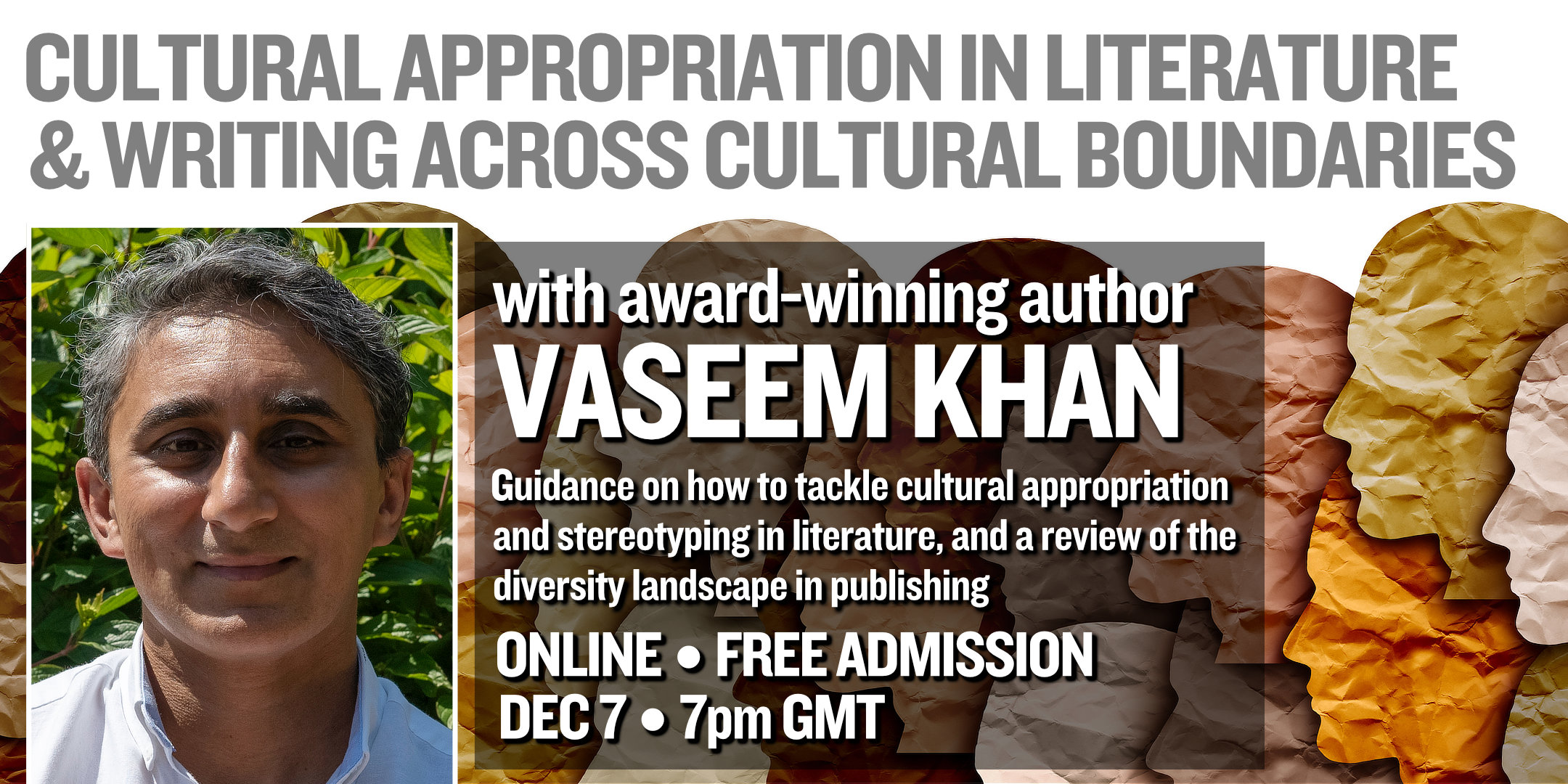
Cultural appropriation: So what’s all the fuss about?

by Vaseem Khan

From films to books to hairstyles, the issue of cultural appropriation has become a hot button topic in recent years, inciting debate and outrage in equal measure. But what exactly is it?

Let’s start with an exercise. I’d like you to click here and watch this video. It’s only 10 mins long, and you don’t have to watch all of it to get some idea of the background to this divisive topic.

This video is the result of a project I carried out this year examining the landscape of diversity in the publishing industry and seeking to provide authors with advice on how to include characters from diverse backgrounds into their fiction, an endeavour that is increasingly fraught with anxiety. The project is called “Turning the page: a guide to writing cultural diversity in fiction.”

Free Event: 7pm, UK time, Dec 7th – You can attend an event where I will present the results from this project and launch a free PDF guide. Register here.

The Oxford English Dictionary now has an entry for the term “cultural appropriation” defining it as “the unacknowledged or inappropriate adoption of the practices, customs, or aesthetics of one social or ethnic group by members of another (typically dominant) community or society.”

Yet, the truth is that writers borrow from other cultures and experiences all the time. When we talk about cultural appropriation, what we really mean is cultural misappropriation: the adoption of elements of one culture or identity by members of another culture in a way that is deemed to cause offence.

But who is drawing the lines here? Who gets to decide what is or is not offensive? And how do evolving viewpoints in society move the goalposts?

Take the crows in the 1941 movie Dumbo, a Disney classic. Today, these once loved characters are considered by some as racist caricatures because of their parodied speech patterns. More recently, the Oscar-winning film La La Land faced criticism because the lead character, a white musician, is shown “whitesplaining” jazz to an African American musician. Jazz is traditionally considered an African American art form. This example illuminates the divisiveness that sometimes arises with modern attitudes to cultural appropriation. After all, who says a white man shouldn’t be passionate about jazz music? At what point does his display of said passion become cultural misappropriation?

In a survey I carried out as part of this project, out of 1033 respondents, 95% stated that all authors should have the right to write characters from ethnicities different to their own. Yet, according to 86% of respondents, there is currently “a climate of fear in the industry around issues of cultural appropriation and voice”.

The fact is that authors are sometimes vilified for writing characters hailing from backgrounds other than their own, with some accusing them of taking the spotlight away from more authentic voices. In some cases, this is justified, particularly where authors have been lazy in their research, indulging in stereotypes and otherwise being disrespectful to the truth of the community they are portraying.

Yet there are also numerous instances of books where authors have been successful writing characters outside of their ethnicity or lived experience. Examples include The Remains of the Day by Kazuo Ishiguro, or Schindler’s Ark by Thomas Keneally, both of which won the Booker Prize.

So how do authors avoid accusations of cultural appropriation? In my project, I attempt to provide a detailed answer to this question, covering such areas as carrying out good research, avoiding stereotypes, and using sensitivity readers where appropriate.

Ultimately, we have to remember that fiction is about creating stories, and stories, by their very nature, are peopled by characters who are not necessarily like us. Writers must have the license to write whatever inspires them. In 2019, Booker-prize winning author Bernardine Evaristo, a black woman, voiced her opinion that it is ridiculous to demand of writers that they not write beyond their own culture.

Most of us would agree with this sentiment.

Free Event: 7pm, UK time, Dec 7th – You can attend an event where I will present the results from this project and launch a free PDF guide. Register here.

Inside India #28: The forgotten fallen – Soldiers of the subcontinent in WW1

This article is one of a series of 50. Together they explore the history and culture of India from her most ancient civilisations to the nation’s ambitious space programme. All 50 articles will be collected into a digital book and published in due course. To receive a FREE copy of the book, simply register for my newsletter here.

In the city of Ypres, some 125 km out from Brussels, the Menin Gate Memorial to the Missing is etched with fifty-five thousand names. Fifty-five thousand fallen soldiers. Of those, four-hundred and forty are the names of soldiers from the subcontinent.

In the autumn of 1914, soon after the commencement of WW1 hostilities, it was Indian jawaans who bore the brunt of the German advance at Ypres; it was Indian infantrymen who helped stop the Germans in their tracks. Indian soldiers similarly distinguished themselves at Gallipoli, and in multiple engagements against the Ottoman Empire across the Middle East.

All in all, over one point three million troops recruited from the subcontinent served in the war, of which seventy thousand perished and almost the same number were wounded.

Attribution: Wellcome Images, CC 4.0

And yet, a century later, out of all those who are remembered for their valiant efforts during the Great War, the Indians are invariably the last to be praised, their contributions glossed over or completely forgotten.

In this respect, the recent Sam Mendes film 1917 generated something of a furore. Following its release, the actor Lawrence Fox stirred controversy by commenting on “the oddness in the casting” of a Sikh soldier in the film. He was duly called to account, and, in fairness to him, duly apologised: “Fellow humans who are Sikhs, I am as moved by the sacrifices your relatives made as I am by the loss of all those who die in war, whatever creed or colour.”

In my personal opinion what should have astonished Fox is the not that an Indian was shown fighting with the British, but the fact that more Indians were not shown. In some ways, this is symptomatic of the way we teach history in the West, and the way that the subcontinental contribution to the Great War (and the contribution of other minorities and foreign fighters) has been neglected as a matter of course.

For the Indians themselves, the war was a genuinely confusing time.

Transported from villages and towns from across the vastness of the subcontinent, usually from the lowest rungs of society, they found themselves bogged down in trench warfare, unable to grasp the language or the culture of those who commanded them, invariably the very men who were sending them charging to their deaths. If they survived for any length of time, they were battling freezing cold, terrain alien to their upbringing, unpalatable food, and an enemy they could not fathom. And all for a country and a cause that was not even their own.

And yet they fought with the courage of proverbial lions. The Sikhs, who made up twenty per cent of the Indian force, particularly distinguished themselves with their bravery and willingness to throw themselves into the fight – for little more than personal honour. The Gurkhas too – both those from Nepal and those born in India – became known for their valiant acts of heroism. Together, these fighting men earned a significant number of military honours, including several Victoria Crosses. (The first Indian to earn a Victoria Cross was Sepoy Khudadad Khan, at the First Battle of Ypres in October, 1914. Khan led his machine gun team in the face of a brutal German onslaught. His entire team was killed and he was left for dead, but survived, and managed to crawl back to his regiment despite severe injury.)

In order to make it easier to recruit such able warriors, the British, eager to use India as a supply line for men and materiel, vowed to deliver the self-rule that the subcontinent’s leading political agitators had begun to demand in the first decade of the new century. It is because of this promise that men like Gandhi temporarily halted – or modified – their growing anti-colonial rhetoric in order to support the war.

But when the war ended the British proved themselves duplicitous.

Instead of self-government, Indians were rewarded with the Rowlatt Act, an onerous piece of legislation that gave the subcontinent’s colonial masters extraordinary powers to bring to heel the nascent revolutionary movement. The Rowlatt Acts directly led to many incidents of brutality against those who continued to protest peacefully against the occupation of their country, none worse than the murder of nine hundred unarmed souls at Jallianwallah Bagh in Amritsar in 1919.

Perhaps this explains why the soldiers who made it back from the various theatres of war found little recognition or sympathy from their countrymen. They were deemed to have fought on the side of the devils, on the side of India’s oppressors.

And perhaps this too explains the lack of First World War memorials in the country, an absence that resonates all the more deeply as we gradually bring to light the great sacrifices made by Indian soldiers in that most terrible of conflicts.

This article is one of a series of 50 that I will be publishing on my website. Together these pieces explore the history and culture of India from her most ancient civilisations to the nation’s ambitious space programme. You can read all 50 pieces here.

All 50 articles will be collected into a digital book and published in due course. To receive a FREE copy of the book, simply register for my newsletter here. The newsletter goes out every three months and contains updates on book releases, articles, competitions, giveaways, and lots of other interesting stuff. 

My latest novel, The Dying Day, is set in India, in the 1950s, and features India’s first female police detective, Persis Wadia, as she investigates the disappearance of one of the world’s great treasures, a 600-year-old copy of Dante’s The Divine Comedy stored at Bombay’s Asiatic Society. Soon bodies begin to pile up… Available from bookshops big and small and online. To see buying options please click here. 

Inside India #27: Ramanujan – The Man Who Dreamed of Infinity

This article is one of a series of 50. Together they explore the history and culture of India from her most ancient civilisations to the nation’s ambitious space programme. All 50 articles will be collected into a digital book and published in due course. To receive a FREE copy of the book, simply register for my newsletter here.

In 2016, a film entitled The Man Who Knew Infinity was released, to considerable critical acclaim. Starring Indian actor Dev Patel, it chronicled the life of Srinivasa Ramanujan, a mathematical genius whose work has been hailed as revolutionary by modern science, yet whose life had long remained shrouded in myth and mystery.

Even now, Ramanujan’s legacy remains a perfect blend of Indian spirituality and western modernity.

Picture attribution: Konrad Jacobs Creative Commons 2.0

Born in 1887 in Madras during British rule, Ramanujan initially did well in school, but later dropped out of college. A second stint at university also failed, due to Ramanujan’s penchant for focusing on mathematics to the detriment of all other subjects. 

Undaunted, he carried on pursuing his passion, making extensive scribblings in a series of now-famous notebooks, discovering numerous formulae, some already known to the mathematical world, some startlingly original.

Following the publication of an article in the Journal of the Indian Mathematical Society, Ramanujan began to correspond with renowned Cambridge University mathematician, G.H. Hardy.

So impressed was Hardy with Ramanujan’s unorthodox but brilliant work that he invited him to Cambridge.

Hardy, like many, was initially perturbed by Ramanujan’s habit of not providing proofs for his results. Unlike many others, however, he was willing to give the Indian the benefit of the doubt, saying, of Ramanujan’s results: “I had never seen anything in the least like them before. A single look at them is enough to show that they could only be written by a mathematician of the highest class. They must be true because, if they were not true, no one would have the imagination to invent them.”

Ramanujan himself claimed that many of his results came to him in sleep, during dreams, given to him via the Hindu goddess Namagiri. He famously said, “An equation has no meaning for me unless it expresses a thought of God.”

During his years at Cambridge, Ramanujan forged an abiding friendship with Hardy, though Hardy, an atheist, never really came to terms with the Indian’s insistence that spirituality played a part in his genius. Ramanujan’s intuitive mathematical ability continued to astound the Englishman. One of the most famous anecdotes of their interaction comes from Hardy himself, a story of a visit he made to see Ramanujan in hospital. “I had ridden in taxi cab number 1729 and remarked that the number seemed to me rather a dull one, and that I hoped it was not an unfavourable omen. ” No,” he replied, “it is a very interesting number; it is the smallest number expressible as the sum of two cubes in two different ways.”

(This is, of course correct. (1729 = 13 + 123 and also 93 + 103.) 1729 is now known as Ramanujan’s number.)

Never physically robust, Ramanujan was forced to return to India in 1919 due to protracted ill health – he died a year later at the age of 32. 

His mathematical legacy has grown with the passing years. During his short life, he independently compiled nearly four thousand results, many of them highly original; astonishingly, nearly all have subsequently been proven correct. His body of work has inspired many new areas of mathematical research, and his notebooks—containing summaries of his published and unpublished results – have been mined as a source of new mathematical ideas.

In 1976, Ramanujan’s so-called ‘lost notebook’ was discovered in the Wren Library at Trinity College, Cambridge.  More a collection of papers rather than an actual notebook, the sheets nevertheless contained some six hundred mathematical formulae discovered during the last year of Ramanujan’s life. The discovery was one of the most significant in the world of mathematics for decades. Some of the formulae have been found to be useful for calculating the entropy of black holes.

Among his many accolades, Ramanujan was the first Indian to be elected a Fellow of Trinity College.

One can only conjecture how many more contributions to the field he would have made had he lived longer.

This article is one of a series of 50 that I will be publishing on my website. Together these pieces explore the history and culture of India from her most ancient civilisations to the nation’s ambitious space programme. You can read all 50 pieces here.

All 50 articles will be collected into a digital book and published in due course. To receive a FREE copy of the book, simply register for my newsletter here. The newsletter goes out every three months and contains updates on book releases, articles, competitions, giveaways, and lots of other interesting stuff. 

My latest novel, The Dying Day, is set in India, in the 1950s, and features India’s first female police detective, Persis Wadia, as she investigates the disappearance of one of the world’s great treasures, a 600-year-old copy of Dante’s The Divine Comedy stored at Bombay’s Asiatic Society. Soon bodies begin to pile up… Available from bookshops big and small and online. To see buying options please click here. 

Have you ever thought of writing crime fiction?

If so, I am delighted to announce that you can now enrol for a new 6-part ONLINE course that I have just recorded for the Curtis Brown Creative Writing School. (Graduates from the school include such crime fiction luminaries as Jane Harper of The Dry fame.)

The course begins on Oct 7th and you can register up until Oct 5th ….

Crime fiction is now the most popular genre in the world. The incredible range within the genre means that there is a niche for everyone. Whether you want to write a nail-biting detective series, cosy mysteries or carefully plotted police procedurals, we will teach you the fundamentals.

Across six weeks, I will guide you through the essentials of writing crime fiction – including mastering the building blocks of a page-turning crime novel, creating memorable detectives with series potential, writing suspense and mystery, setting up red herrings and plotting your investigation all the way to a satisfying conclusion.

You will learn how to construct the perfect murder, establish a crime scene rich with clues and false leads, and make good use of research in key areas such as forensics to make your story more real for the reader.

https://youtube.com/watch?v=A8QW95tzwPY%3Fversion%3D3%26rel%3D1%26showsearch%3D0%26showinfo%3D1%26iv_load_policy%3D1%26fs%3D1%26hl%3Den%26autohide%3D2%26wmode%3Dtransparent

In addition to the teaching videos, detailed notes, and resources, I will set weekly writing tasks that will help you practise the skills you’re learning and bring them to bear directly on your novel. These range from exploring the theme of your crime novel to creating an alternative suspects table and adding layers of clues, intrigue and questions. All students will receive a short piece of written feedback on one writing task from an expert editor during the course.

The course will help you plot, plan, and write a crime worth solving. Each week you’ll grow in confidence as you work towards answering that all-important question: whodunnit? By the end of your course, you should have written at least a 3,000 word opening and constructed your plot.

This course is perfect for fans of crime fiction who now want to write their own murder mystery as well as those who already have experience with the craft of storytelling and want to learn more about the nuances of the crime genre.

Find out more by clicking here