THE EDGE OF DARKNESS is now out!

The Edge of Darkness, the sixth novel in my multi-award-winning Malabar House historical mystery series, featuring India’s first female police detective and an English forensic scientist from Scotland Yard posted to India, is now out. … It’s 1951, Naga Hills, India. A headless corpse turns up inside a locked room at the crumbling Hotel Victoria … Murder, history & mystery, all set against the backdrop of a jungle insurgency… Some buying options here: https://vaseemkhan.com/the-edge-of-darkness/

The below piece tells you a bit more about the background to the book – it first appeared in History Magazine. Enjoy!

Headhunters of the Naga Hills

22 January 2026 By Vaseem Khan

Entrance to Naga hills, Nagaland

Vaseem Khan’s latest murder mystery is set in Nagaland, in the north-eastern region of India. He writes about the history of the area once known as the Naga Hills and the tribes who lived there – people who were, until fairly recently, headhunters.

In the far north-eastern corner of India is the state of Nagaland, the site of an insurgency that has been active since India threw off the British yoke in 1947. Following independence, the local Naga population split into those who favoured continuing as part of the new India – with all that entailed – and those who wanted to go their own way. Various names were proposed for this new territory: Greater Nagaland. Nagalim. An independent nation for the Naga people.

A young man of the Konyak Naga tribe, India, holding a human head

The region provides the backdrop for The Edge of Darkness, the sixth novel in my Malabar House historical mystery series, featuring India’s first female police detective and an English forensic scientist from Scotland Yard posted to India.

Before the end of British rule on the subcontinent, the area was known as the Naga Hills, a district within the Assam province of British India, and home to over a dozen native tribes, notorious for their enthusiastic battle habit of headhunting, a practice that, allegedly, continued into the middle of the 20th century.

The Edge of Darkness sees Inspector Persis Wadia banished to a tiny police station in the town of Kohimain the Naga Hills. Whilst temporarily billeted at the Hotel Victoria, an old colonial-era hotel, she is called to a locked suite on the hotel’s top floor. Inside, she discovers the headless corpse of the region’s political governor.

The novel is essentially a locked room and closed circle mystery, set against the backdrop of the burgeoning Naga insurgency. Persis is tasked with solving the murder, knowing that failure on her part could lead to a heavy-handed response from the central government, intent on blaming local insurgents for the killing.

People celebrating the annual Hornbill festival with traditional dance

But there are other suspects in play; namely Persis’s fellow residents at the hotel, a mix of colourful characters including an American mining company boss, an Italian journalist, and a pair of Baptist preachers.

India’s northeastern tribes have long been a law unto themselves, out in the misty hinterlands beyond the so-called ‘chicken’s neck’, that narrow pass that connects mainland India to the semi-tropical tea-growing regions of the northeast.

Persis, like many Indians of the time, knows nothing of the Naga Hills save the little she has gleaned from Pathé News snippets, and a book her father presses into her hands on the day she departs: The Naked Nagas by Christoph von Fürer-Haimendorf.

The book’s subtitle is telling: Head Hunters of Assam in Peace and War. Von Fürer-Haimendorf, an Austrian ethnologist who spent decades studying the tribes of northeast India, was the first to document the individual characteristics of the various tribes, their divisions and their culture.

Headhunter from the Konyak tribe of Nagaland

When the British arrived en masse, soldiering their way into the jungle, they were unsure what to make of the Nagas and their wild Shangri La. In time, they built railway lines into the interior, spearing into uncharted forests, inevitably fetching up against the brute reality of engineering in the tropics.

Many a British engineer was sent packing by a combination of heat, malaria, and the unwillingness of the natives to play ball with their own subjugation.

Or perhaps it was stories of the Naga penchant for collecting heads and using them to decorate their distinctive huts that sent watery-bowelled Englishmen running back to Blighty?

Headhunting and the Naga tribes enjoy a long and complicated history. Naga youth earned their spurs by the heads they brought back from the battlefield. The practice was only officially banned in 1969, with the last cases reported in the early 1960s. The gradual lapsing of the custom can be credited to the proliferation of Christianity, brought to the region by British missionaries and then, even more fervently, by American Baptists.

Conversion was no easy task and early Naga Christians found it difficult to completely abandon their animist leanings, syncretising a unique blend of Protestantism and their ancient pagan faith.

View of the Burmese landscape from the Dimapur-Kohima road near Imphal, 1942

During WW2, the region briefly flickered across the consciousness of the Allied High Command. The Battle of Kohimaremains one of the bloodiest of WWII, known today as the ‘Stalingrad of the East’.

The conflict centred on a Japanese attempt to advance into India through Burma, hacking their way through the dense jungle that blankets the subcontinent’s eastern reaches.

In April, 1944, the Japanese 15th Army worked its way up from Imphal to the Kohima Ridge – in the Naga Hills – where it was met by troops from the British IV Corps. The resulting battle, 64 days of mayhem, left 10,000 dead and the region devastated.

The fighting was particularly fierce around the bungalow of the Naga Hills district’s deputy commissioner, which stood on the hillside at a bend in the road, housing, among other things, a private tennis facility.

The Battle of the Tennis Court, an encounter that would later invite comparisons to the massacre at Verdun, saw the combatants dug into slit trenches so close they were able to lob grenades at one another.

The mined tennis court and terraces of the District Commissioner's bungalow in Kohima

Ultimately, the Japanese were beaten back due to a tactical miscalculation. They ran out of food. Many later died of starvation as they withdrew back into the jungle.

Three years later, the Naga National Council declared ‘independence’ on 14th August 1947, one day before India officially became independent from Britain.

In 1963, the Naga Hills region became an Indian state called Nagaland. An insurgency in the region in support of Nagaland’s independence has been ongoing till today, with many deaths on both sides, and regular accusations of murder and torture.

The fact that America’s CIA has been involved in supporting this insurgency has been recorded in official assessments of the region by several sources.

In The Edge of Darkness I hope to capture the wild beauty and political turmoil of the jungle home of the Nagas. With a dead body or two thrown in for good measure.

The Edge of Darkness by Vaseem Khan is published on 22 January, 2026. It’s the sixth in his Malabar House series.

Read more about this book.

Vaseem is a former chair of the UK Crime Writers’ Association and the author of several award-winning crime series including the Baby Ganesh Agency novels, set in modern Mumbai, and the Malabar House historical crime series, set in 1950s Bombay. He’s also written Quantum of Menace, the first in a series featuring Q from the world of James Bond.

vaseemkhan.com

You may enjoy reading Vaseem’s other Historia features:
Calcutta Blues: why Kipling despised the city
Partition, politics, and a prime minister’s passion

Other features on the history of India include:
1920s Bangalore, a city of diversities and
Magic versus jadoo in 1920s British Colonial India, both by Harini Nagendra
It’s time to remember Ganga Singh: maharaja, reformer, statesman by Alec Marsh
Unforgettable legacies of the East India Company by Vayu Naidu
Re-examining the history of Empire in fact and fiction by Tom Williams
Finding empathy – the complexities of writing Robert Clive by Diana Preston

Images:

  1. The entrance to the Naga hills, Nagaland: Girish Mohan PK for Wikimedia (CC BY-SA 4.0)
  2. A young man of the Konyak Naga tribe, India, holding a human headWellcome Collection (public domain)
  3. People celebrating the annual Hornbill festival with traditional dance, Nagaland: Kaushik Mishra for Wikimedia (CC BY-SA 4.0)
  4. Headhunter from the Konyak tribe of Nagaland: Avantikac98 for Wikimedia (CC BY-SA 4.0)
  5. View of the Burmese landscape from the Dimapur-Kohima road near Imphal, 1942: IWM (COL 214)(IWM Non Commercial Licence)
  6. The mined tennis court and terraces of the District Commissioner’s bungalow in Kohima, July, 1944: IWM (IND 3483) (IWM Non Commercial Licence)

Extract from CITY OF DESTRUCTION – the fifth Malabar House novel – out on Nov 24!

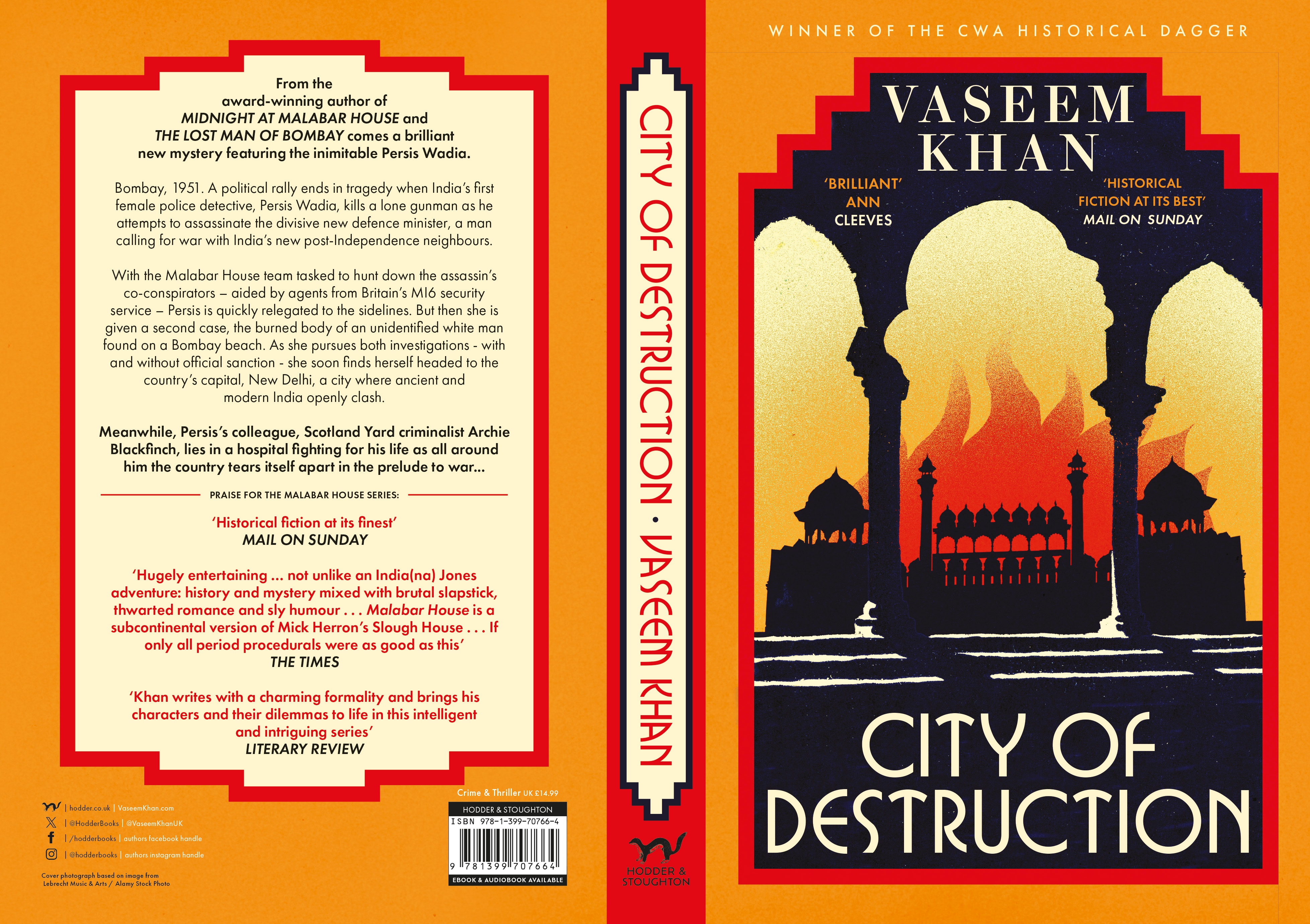
I’m very excited to announce that the fifth in my Malabar House series, CITY OF DESTRUCTION, is out in hardback (and digital) format this Nov in the UK, with other countries following soon after. Here’s the cover and description, with pre-order links, and an extract below.

City of Destruction

Bombay, 1951  

A political rally ends in tragedy when India’s first female police detective, Persis Wadia, kills a lone gunman as he attempts to assassinate the divisive new defence minister, a man calling for war with India’s new post-Independence neighbours. With the Malabar House team tasked to hunt down the assassin’s co-conspirators – aided by agents from Britain’s MI6 security service – Persis is quickly relegated to the sidelines. But then she is given a second case, the burned body of an unidentified white man found on a Bombay beach. As she pursues both investigations – with and without official sanction – she soon finds herself headed to the country’s capital, New Delhi, a city where ancient and modern India openly clash. Meanwhile, Persis’s colleague, Scotland Yard criminalist, Archie Blackfinch, lies in a hospital fighting for his life, as all around him the country tears itself apart in the prelude to war…

Pre-orders really help a book, so I would be immensely grateful if you ordered the book. You can order from all good bookshops including here: Waterstones or Amazon (Note: The US hardback will launch on March 4 2025, though the Kindle version will be out on Nov 28 2024. Pre-order from bookshops or here.

The below is a pre-publication extract from CITY OF DESTRUCTION, a novel by Vaseem Khan

CITY OF DESTRUCTION

by Vaseem Khan

They found the body curled up on a cracked shelf of black rock lapped at by the warm waters of the Arabian Sea, down by the tip of the Malabar Hill peninsular.
Parking the jeep on a dirt track leading from the main road, they made their way over the rocks to the corpse. The sun floated high overhead, in a sky of electric blue. Light made an ever-shifting tracery of prisms on the water’s surface.
A crowd had gathered, though not of the human variety.
The smell of death had its own bouquet and to a certain cross section of Bombay’s population the noxious odour of a burned body was akin to the aromas emanating from the five-star kitchens of the Taj Mahal Hotel. A gang of rooting pigs had turned up, accompanied by a pack of stray dogs, a brace of langurs, a flock of gulls, ravens and crows, and a goodly contingent of Bombay’s ubiquitous rat population. They were being kept at bay by a wizened homunculus in a uniform so big it made him look like an overgrown child. Handlebar moustaches hung to his pigeon chest.
Persis watched the cut-price Zorro fence at the slavering menagerie with a bamboo lathi.
Birla exchanged words with the man and determined that he was employed as a security guard at the home of the individual who had found the body, a retired executive who lived in one of the imposing homes set well back from the rocky shore. The man had been taking his daily early morning constitutional and stumbled across the body, almost losing his breakfast in the process.
Persis focused on the corpse.
The cadaver was curled into a foetal position, burned black. A few wisps of black hair remained on the skull, but the face was burned beyond recognition. The rest of the body too had clearly been engulfed by flame.
Despite the heat, a chill ran through her.
Death had rarely rattled her. Even at the academy, she had maintained a relative indifference when confronted by cadavers in the training morgue, looking on as many of her male colleagues had turned various shades of green. Her mother’s death and Sam’s grim fatalism had infected her at an early age. Death, after all, was the ultimate democratic institution. It came for everyone, rich or poor, moral or wicked. There was little point in being frightened of it.
But anger, at the iniquitous nature of some deaths . . . Now that was permitted.
What had driven this man to his death? Was it, as Roshan Seth had supposed, a case of self-immolation? Across Bombay, many had chosen this form of protest of late, the last mode of self-expression left to the truly desperate.
Little good that it did.
In the city of dreams, the crowd that invariably gathered as yet another protestor doused himself in gasoline outside yet another government office was as likely to offer a match as it was to come to the poor fool’s rescue.
Birla cut into her thoughts. ‘The last time I smelled anything this bad, an elephant had done its business over my head.’
She decided not to ask. With Birla, a tale of woe – of which he had an inexhaustible supply – could be counted upon to take the listener down the sort of dark and winding path that usually ended in a mugging.
She saw that the sub-inspector had tied a handkerchief around his mouth, giving him the look of a particularly inept highwayman.
He was a strange man. Relegated to Malabar House because his daughter had refused the amorous attentions of a senior officer, Birla, like Persis herself, was a victim of circumstance rather than incompetence. Though he would have been the first to admit that, prior to his banishment, his career had managed to achieve as much forward momentum as a car with square wheels. Some men were born to mediocrity, some achieved it, and some had it thrust upon them. Birla was the result when all three aligned in a single individual.
Nevertheless, of all of her fellow officers at Malabar House, Birla was the one who had been most willing to offer her acceptance. The fact that he was continually braced by two no-nonsense women at home had, perhaps, made it easier for him to do so. That and the fear that his wife might give him a good talking-to were he to adopt any other attitude.
What was she doing here?
Her every cell itched to be away from this godforsaken place, back in the thick of it. She should be out pursuing the real investigation, not standing here on this lonely slab of broken rock, surrounded by wild animals, mute witnesses to another chapter in the litany of human depravity that circumscribed the city they all called home.
But Seth was right. When you pulled on the uniform, you gave the dead and the dispossessed certain rights. The right to demand justice, for one.
Whether you could deliver it or not was a different matter.
‘Why come out here to do this?’ Birla’s voice was muffled behind his makeshift facemask. ‘What would be the point? You wouldn’t catch me setting fire to myself without an audience.’
She waited while he mentally traversed the winding pathway of his own question and arrived at the logical conclusion.
‘He didn’t do this to himself, did he?’ said the sub-inspector, quietly. ‘Someone did this to him.’
She gestured at the desolate rocks. ‘You’re right in that this would be the last place in Bombay to commit such an act. And how did he get out here? There’s no vehicle on the road.’
‘Perhaps he walked? Or took a cab?’
‘In which case, we should be able to track it down. Besides, a body this badly burned needs an accelerant. A petrol can. A container. There’s nothing here.’
‘Maybe he threw it into the sea before he set himself alight?’
‘Possibly. But it doesn’t feel right. Something terrible happened here.’
Birla looked back down at the body. ‘So someone killed him. And left the body out here, thinking that perhaps the tide would sweep it out to sea.’
She nodded. Birla had always been smarter than he looked, possessed of a low cunning that occasionally allowed him to leap to the right answer.
‘Whoever did this didn’t realise that the tide rarely gets this far up the rocks.’
The sub-inspector blew out a breath of disgust, ruffling the handkerchief around his mouth. He peered darkly at the corpse as if by some supernatural effort of will he might resurrect it or, better yet, make it vanish. ‘I suppose I better find a telephone,’ he muttered. ‘Call out the meat wagon.’
A raven hopped closer. He aimed a kick at it. The bird seemed unimpressed – it was almost the same size as Birla, and looked twice as vicious.

Pre-order now. Pre-orders really help a book. You can order from all good bookshops including here: Waterstones or Amazon (Note: The US hardback will launch on March 4 2025, though the Kindle version will be out on Nov 28 2024. Pre-order from bookshops or here.