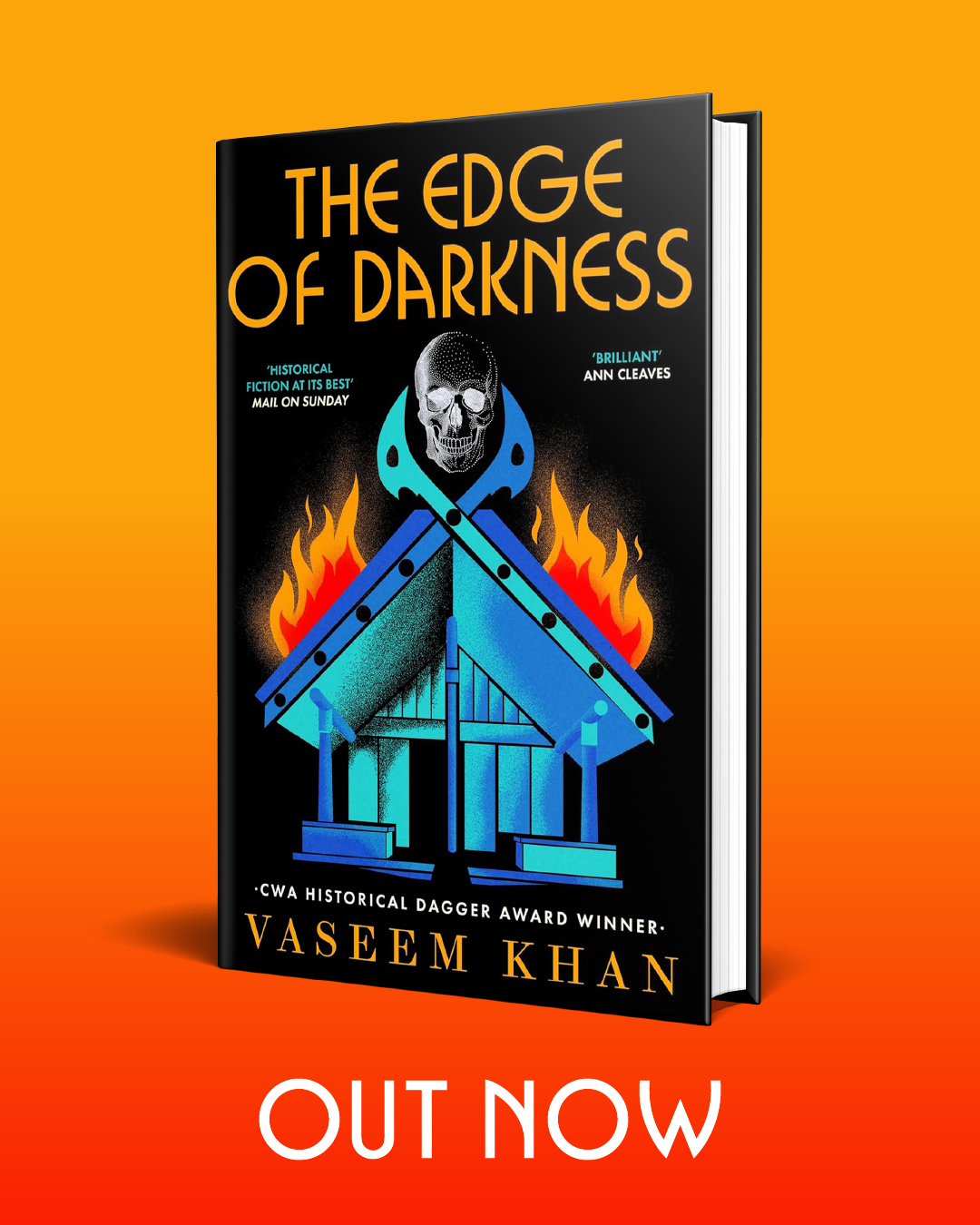
The Edge of Darkness, the sixth novel in my multi-award-winning Malabar House historical mystery series, featuring India’s first female police detective and an English forensic scientist from Scotland Yard posted to India, is now out. … It’s 1951, Naga Hills, India. A headless corpse turns up inside a locked room at the crumbling Hotel Victoria … Murder, history & mystery, all set against the backdrop of a jungle insurgency… Some buying options here: https://vaseemkhan.com/the-edge-of-darkness/
The below piece tells you a bit more about the background to the book – it first appeared in History Magazine. Enjoy!
Vaseem Khan’s latest murder mystery is set in Nagaland, in the north-eastern region of India. He writes about the history of the area once known as the Naga Hills and the tribes who lived there – people who were, until fairly recently, headhunters.
In the far north-eastern corner of India is the state of Nagaland, the site of an insurgency that has been active since India threw off the British yoke in 1947. Following independence, the local Naga population split into those who favoured continuing as part of the new India – with all that entailed – and those who wanted to go their own way. Various names were proposed for this new territory: Greater Nagaland. Nagalim. An independent nation for the Naga people.
The region provides the backdrop for The Edge of Darkness, the sixth novel in my Malabar House historical mystery series, featuring India’s first female police detective and an English forensic scientist from Scotland Yard posted to India.
Before the end of British rule on the subcontinent, the area was known as the Naga Hills, a district within the Assam province of British India, and home to over a dozen native tribes, notorious for their enthusiastic battle habit of headhunting, a practice that, allegedly, continued into the middle of the 20th century.
The Edge of Darkness sees Inspector Persis Wadia banished to a tiny police station in the town of Kohimain the Naga Hills. Whilst temporarily billeted at the Hotel Victoria, an old colonial-era hotel, she is called to a locked suite on the hotel’s top floor. Inside, she discovers the headless corpse of the region’s political governor.
The novel is essentially a locked room and closed circle mystery, set against the backdrop of the burgeoning Naga insurgency. Persis is tasked with solving the murder, knowing that failure on her part could lead to a heavy-handed response from the central government, intent on blaming local insurgents for the killing.
But there are other suspects in play; namely Persis’s fellow residents at the hotel, a mix of colourful characters including an American mining company boss, an Italian journalist, and a pair of Baptist preachers.
India’s northeastern tribes have long been a law unto themselves, out in the misty hinterlands beyond the so-called ‘chicken’s neck’, that narrow pass that connects mainland India to the semi-tropical tea-growing regions of the northeast.
Persis, like many Indians of the time, knows nothing of the Naga Hills save the little she has gleaned from Pathé News snippets, and a book her father presses into her hands on the day she departs: The Naked Nagas by Christoph von Fürer-Haimendorf.
The book’s subtitle is telling: Head Hunters of Assam in Peace and War. Von Fürer-Haimendorf, an Austrian ethnologist who spent decades studying the tribes of northeast India, was the first to document the individual characteristics of the various tribes, their divisions and their culture.
When the British arrived en masse, soldiering their way into the jungle, they were unsure what to make of the Nagas and their wild Shangri La. In time, they built railway lines into the interior, spearing into uncharted forests, inevitably fetching up against the brute reality of engineering in the tropics.
Many a British engineer was sent packing by a combination of heat, malaria, and the unwillingness of the natives to play ball with their own subjugation.
Or perhaps it was stories of the Naga penchant for collecting heads and using them to decorate their distinctive huts that sent watery-bowelled Englishmen running back to Blighty?
Headhunting and the Naga tribes enjoy a long and complicated history. Naga youth earned their spurs by the heads they brought back from the battlefield. The practice was only officially banned in 1969, with the last cases reported in the early 1960s. The gradual lapsing of the custom can be credited to the proliferation of Christianity, brought to the region by British missionaries and then, even more fervently, by American Baptists.
Conversion was no easy task and early Naga Christians found it difficult to completely abandon their animist leanings, syncretising a unique blend of Protestantism and their ancient pagan faith.
During WW2, the region briefly flickered across the consciousness of the Allied High Command. The Battle of Kohimaremains one of the bloodiest of WWII, known today as the ‘Stalingrad of the East’.
The conflict centred on a Japanese attempt to advance into India through Burma, hacking their way through the dense jungle that blankets the subcontinent’s eastern reaches.
In April, 1944, the Japanese 15th Army worked its way up from Imphal to the Kohima Ridge – in the Naga Hills – where it was met by troops from the British IV Corps. The resulting battle, 64 days of mayhem, left 10,000 dead and the region devastated.
The fighting was particularly fierce around the bungalow of the Naga Hills district’s deputy commissioner, which stood on the hillside at a bend in the road, housing, among other things, a private tennis facility.
The Battle of the Tennis Court, an encounter that would later invite comparisons to the massacre at Verdun, saw the combatants dug into slit trenches so close they were able to lob grenades at one another.
Ultimately, the Japanese were beaten back due to a tactical miscalculation. They ran out of food. Many later died of starvation as they withdrew back into the jungle.
Three years later, the Naga National Council declared ‘independence’ on 14th August 1947, one day before India officially became independent from Britain.
The fact that America’s CIA has been involved in supporting this insurgency has been recorded in official assessments of the region by several sources.
In The Edge of Darkness I hope to capture the wild beauty and political turmoil of the jungle home of the Nagas. With a dead body or two thrown in for good measure.
Vaseem is a former chair of the UK Crime Writers’ Association and the author of several award-winning crime series including the Baby Ganesh Agency novels, set in modern Mumbai, and the Malabar House historical crime series, set in 1950s Bombay. He’s also written Quantum of Menace, the first in a series featuring Q from the world of James Bond.
This free short story marks the publication of THE EDGE OF DARKNESS on 22 JAN 2026, the sixth book in the Malabar House series. The first in the series, MIDNIGHT AT MALABAR HOUSE, won the Crime Writers’ Association Historical Dagger. … It’s 1951, India. Inspector Persis Wadia is banished to the jungles of the Naga Hills district in the far northeast, where the headless body of the local governor is found inside a locked room… Murder, mystery and political intrigue… If this sounds like your thing, do consider pre-ordering the book. You can find more details and options for pre-ordering THE EDGE OF DARKNESS here. To receive further short stories, competitions etc join Vaseem Khan’s newsletter here.
THE LAST KING OF BURMA
1
Bombay, 1950
The two-storey bungalow on Nepean Sea Road had been used as a safe house during the freedom struggle. Surrounded by tall rain trees whose branches knocked on the shuttered green windows of the upper elevation, it had once served a family that had made its fortune in the British-controlled cotton trade, before the Quit India movement had ignited a latent patriotism. Independence had proved bittersweet. The Muslim family had fled to the newly-created Pakistan just months before Nehru took the helm of a reshaped India.
The man who had purchased the home from its departing residents now lay dead in a copper-bottomed bathtub on the upper floor.
Inspector Persis Wadia, called to the scene shortly after arriving, an hour earlier, at the nearby Malabar House station – Bombay’s smallest and most disreputable police establishment – was led through the house by Mohan Kher, personal aide to the murdered man. If Kher was intrigued by the sight of the country’s first – and only – female police detective, he made no hint of it.
Kher, dressed in a chalk-striped grey suit and tie, cut a tall, slender figure, an urbane man in his forties, a hint of grey at the temples, a sharp chin, and wire-framed eyeglasses. A trio of smudged white lines across his brow hinted at a recent temple visit. His polished Oxfords clacked loudly on the wooden staircase.
‘The mali found the bodies,’ he said over his shoulder. ‘He telephoned me.’
They arrived on the second floor. Kher led her to an open doorway, paused for a moment with a hand on the frame, then entered.
A white man lay in the tub, head lolled back, one fleshy arm hanging limp over the side, the water opaque with blood. His name, she knew, was John Maxwell. She judged him to be in his fifties, a haggard face, made more so by death, a short beard, and greying hair.
His throat had been cut. She felt something uncoil in her guts.
She turned to Kher, who had blanched, his gaze held by the body.
‘Tell me about him.’
He shuddered, then turned to her. Grief darkened his features.
‘He was a great man. One of those Scotsmen who came to India as a boy and spent the rest of his life here. He worked for Burmah Oil. We both did. We were posted in Rangoon until the Japanese invasion in ’42. We were forced to abandon everything we’d built – our homes, the company – and trek across the jungle to Assam. From there we made our way down to Calcutta. In time, Burmah Oil gave John a position in the Bombay office.’
‘And you went with him?’
‘I’ve been his aide for almost two decades. He was more than my employer. He was my friend.’ He glanced again at the body, and then, in a whisper, ‘He saved my life on the road from Burma. And now…’ He waved a helpless hand at the greying slab of flesh.
She heard a clatter behind her and turned to find Blackfinch arriving with his young assistant, Mohammed, trundling a large, boxy case.
The Englishman greeted her awkwardly. ‘Persis.’
‘Archie.’
The stiffness between them flushed her insides with an uncomfortable heat. It was her own fault. She should never have stepped over the invisible line that kept whites and Indians apart in the new India. A public romance between her and Blackfinch was unthinkable. Now, like soldiers who had fought an indecisive skirmish, and didn’t know whether to return to their respective trenches or re-engage, they were at a loss. That they were forced to routinely work together was all but unbearable.
She introduced Kher. ‘Archie Blackfinch is a criminalist with the Metropolitan Police in England. He’s currently helping the Bombay police set up a forensics laboratory. I asked him here to examine the crime scene.’
Kher looked perturbed, then nodded. ‘In that case, perhaps I should show you the second body?’
2
The woman was young, in her early twenties, dressed in an olive sari, dark-skinned, and pretty.
She lay on the floor of the kitchen, the front of her sari soaked in blood, sightless eyes staring at the gently rotating ceiling fan.
‘Her name is Laxmi Vyas,’ said Kher. ‘She is – she was– the housekeeper.’
‘She lived here?’
‘Yes. In a downstairs room. She joined the household six months ago.’ Kher shook his head sadly. ‘Do you think it was a burglary? Or do you think they came for John?’
‘They?’
He blinked. ‘Nationalists. The ones who won’t rest until every foreigner leaves India.’
The theory had some truth to it. Even now, three years after Independence, tens of thousands of Brits stayed on in the country. Some had known no other home; others could not imagine returning to the cold, wet suburbs of the old country. Here, like Maxwell, they were burra sahibs, little emperors, waited on hand and foot by their former subjects.
She recalled the strife-ridden years of the struggle, the vehemence with which many had pursued the ouster of foreigners, the violence directed towards them, despite Gandhi’s pleas. There were still hardline elements who believed in forcibly cleansing the country of the remaining vestiges of empire.
‘Too early to tell,’ she replied. ‘Did he have any enemies?’
‘He had rivals. I wouldn’t call them enemies.’
‘Please explain.’
‘John was the key figure for Burmah Oil in a lawsuit against the British Government. In the retreat from Burma, British soldiers were ordered to set fire to our oilfields to prevent them falling into the hands of the enemy. Burmah Oil contends that we should be duly compensated. The British government disagrees. The legal battle has become a bitter affair.’
‘You believe this murder was orchestrated by the British government?’ She allowed a note of incredulity to enter her tone.
‘The British so hate to lose, don’t they?’
The idea seemed far-fetched and she could not take it seriously. Not yet. ‘I’d like to see the rest of the house.’
3
In Maxwell’s study, she found a photograph of him as a younger man, a red-faced son of empire posing beside the carcasses of a trio of leopards, a shotgun cracked open in the crook of his elbow.
A search of his desk turned up little of value.
‘I take it he wasn’t married?’
‘He was a widower,’ replied Kher. ‘His wife died in Burma.’
‘Children?’
‘No. They were childless.’
‘He never remarried?’
‘No. He loved his first wife very much.’
Blackfinch entered the room. ‘Banerji has certified the deaths.’
She nodded. The prim and unlikeable Dr Banerji, with his sallow face and prissy bow ties, was as efficient as he was uncommunicative. Or perhaps his sullen manner had more to do with the fact that she was the force’s only female detective. Engaging her in conversation seemed to make him gag, as if he’d gargled battery acid.
‘We’ll need the post mortem to confirm,’ Blackfinch continued, ‘but, by my estimation, they were both murdered with a large-bladed knife. She was stabbed at least six times in the chest and stomach. His throat was cut. No sign of the weapon and, frankly, no other forensic artefacts at this time.’ He reached up and touched his spectacles. His green eyes blinked behind the round lenses. A dark-haired, handsome man, even if, in Persis’s opinion, he had the social abilities of a concussed camel. ‘I think our burglar came in over the compound wall late last night, entered through an unlatched door at the rear of the house, stumbled across the maid in the kitchen, killed her, then came upstairs. My guess is Maxwell was dozing in the tub, didn’t even realise anything was amiss until the killer had slit his throat.’
He articulated the gruesome scenario as if reading out a report of the day’s cricket.
She directed herself to Kher. ‘Can you tell me if anything of value is missing?’
‘I can try.’
4
Half an hour later, they had completed a search of the house.
Going through Maxwell’s wardrobe, Persis discovered a wallet in the pocket of a blazer. Inside, a few hundred rupees in cash, and a folded receipt, stamped with the crest of a prominent Bombay jewellery store: Premlal & Sons. The receipt indicated that Maxwell had purchased – and collected – an expensive diamond ring just days before his death.
On the receipt was the inscription he had asked to be engraved on the ring.
Punarjanmanē mriyāmahē
Her Hindi was good but this was more formal. Sanskrit.
She handed the slip to Kher. ‘Do you know what this means?’
‘“We die to be reborn.”’ He all but whispered the words.
A strange thing to inscribe on a ring. And why had Maxwell, a Scot, chosen Sanskrit? She pondered the words, then said, ‘Why would a widower buy a diamond ring?’
His lips pursed. ‘This must be for Miss Matilda.’
‘Matilda?’
‘John had been courting a woman for the past year. I hadn’t realised that he’d decided to marry.’ He seemed perturbed that his friend had kept such a decision from him.
‘The ring isn’t here.’
He handed back the receipt. ‘Perhaps our killer took it?’
‘What else did he take?’
Kher contemplated the question. ‘There were a pair of solid silver engraved thabeik bowls. They were the only items we managed to leave with when we abandoned Burma. They were exceedingly valuable.’
‘Who knew about the bowls?’
‘It was no secret. John would use them as props when retelling the story of our escape. Perhaps his killer came to steal them, and the murders simply… happened.’
It was as good a theory as any. ‘I’d like to speak with his intended fiancé.’
5
Matilda Harrison was in her late forties, an austere-looking woman, impeccable in a yellow cotton wrap dress falling to just below the knees. Her blonde hair was styled into victory rolls – a hangover from the war years – and her cheeks were rouged. She could not have been called beautiful, but there was a forced elegance about her that spoke to a certain sense of determination.
They met at a restaurant in Nariman Point.
As the lunchtime service clattered around them, Persis waited while the woman ordered a martini. This wasn’t the venue she would have chosen to break the news of a loved one’s demise, but Harrison had declined to step outside.
She explained the reason for her visit, observing the woman’s reaction. A freezing of the features, a tremble of disbelief, and then the realisation that this unusual woman in a khaki uniform had told her nothing but the terrible truth.
A silence yawned between them, and then Harrison lifted her glass and drained it.
‘John’s dead.’ It was not a question, merely an affirmation of fact.
Persis allowed a moment. ‘May I ask you a few questions?’
Harrison looked at her sharply. ‘It’s usual to offer condolences.’
Persis acknowledged this with a nod, then said, ‘How long had you known him?’
Harrison took a deep breath, composed herself. ‘Almost a year. We met in Bombay, at a bridge game organised by mutual friends. We hit it off. Two Scots, two widowers. We had a lot in common.’
‘How did you lose your husband?’
‘He was a soldier. He served as a recruiting sergeant in the Punjab, raising Indian regiments. In the end, they shipped him off to war. He never came back.’
She said this matter-of-factly. Old wounds. The woman’s composure was remarkable. Having weathered the initial shock, her distress seemed to have evaporated. Intriguing.
‘Did John propose marriage?’
This earned her another sharp look. ‘What business is that of yours?’
Persis took out the receipt and handed it to her. ‘He purchased what looks like an engagement ring. It appears to be missing from his home.’
She continued to stare at the slip of paper. ‘Oh, John,’ she murmured. A tremor shook her shoulders. She still hadn’t wept, Persis noted. A woman in control of her emotions. Or was there something more to it?
‘I hadn’t realised he was intending to propose.’
‘But you hoped?’
A grimace.. ‘At my age, what is left except hope, Inspector? To be frank, he’d been increasingly distant these past months. I half expected him to break things off, not… this.’
‘Do you know why he chose that inscription? It means “We die to be reborn.”’
The crow’s feet at the corners of her eyes crinkled. ‘No. But that was John. He always did have a dark sense of humour.’
6
Something about the inscription continued to bother her.
She made her way to the store where Maxwell had made the purchase, found herself in conversation with the man who had sold him the ring.
‘Yes. I remember Mr Maxwell very well.’ The young man was more than an attendant. He was the youngest son of the store’s owner, immaculately dressed in herringbone tweed and two-toned shoes. A pencil moustache, Brylcreemed hair, and an acrid cologne that felled flies in mid-flight. ‘A gentleman who knew his own mind.’
‘Did you suggest the inscription to him?’
‘No. He expressly asked for it.’
‘Didn’t it seem unusual to you? We die to be reborn? It hardly seems apt for an engagement ring.’
He gave her a condescending smile. ‘Have you received a great many engagement rings, Inspector?’
She resisted the urge to wipe the smirk from his face, possibly by shoving the barrel of her revolver into his mouth. He seemed to notice her irritation, and coughed abruptly. ‘He told me that he’d chosen those words because they symbolised his union with the woman he intended to marry. In a sense, he was being reborn. He was leaving behind his old life, everything that he had been. I suppose he’d become somewhat possessed by romantic notions.’ He indulged in a cautious smile.
A sudden thought gripped Persis, as clear as a tolling bell. ‘Did Maxwell mention the name of his intended fiancé?’
‘No.’
‘Did you ask him?’
‘Yes. But he declined to share that information.’
‘Why?’
The question seemed to perplex him.
‘What I mean is, why keep it from you?’
‘Well, I-I don’t really know.’
7
Malabar House was all but deserted.
She found Roshan Seth in his office, scribbling in a notepad, and in a rare good mood. The superintendent had once been a rising star on the Bombay force before Independence had run a tank over his ambitions. Accused by rivals of pursuing his duty a little too zealously under the British, he was now sidelined to the force’s smallest station, ostensibly in charge of others similarly in bad odour.
She went over the details of the case.
‘What makes you think it wasn’t a random burglary?’ said Seth. He nursed a whisky in his large hands, one of several he would down during the day, Persis knew. There were times when she had found her commanding officer on his back behind his desk, gently snoring away the ignominy of his downfall.
‘There’s something about it. Something too precise.’
He grunted. ‘Perhaps his aide is right? If Maxwell was picking a fight with the British government, he was asking for trouble. Losing such a case would set a terrible precedent. I mean, the powers that be would hardly wish the British army rendered answerable for its actions.’ His tone was dry.
‘It doesn’t seem credible. Even the British would baulk at having a man killed on foreign soil.’
He snorted, derisively.
Back at her desk, a peon arrived with Archie Blackfinch’s initial findings from the crime scene, and a set of photographs taken by his assistant. Autopsies were scheduled for the following day, though she doubted there was anything more they could learn. The cause of death was not in any doubt. Blackfinch’s preliminary analysis had been thorough.
Her eyes flicked over his description of the wounds…
Something snagged.
Blood on the fingers of the dead maid’s left hand. Blackfinch’s report stated that the blood came from cut marks on the fourth finger.
He’d speculated that she’d cut herself while cooking. But the cuts were fresh. What would she have been cooking that late at night? Why had she even been in the kitchen?
A sudden burst of electricity arced in her stomach like trapped lightning.
The shape of an answer.
8
‘Tell me about her.’
The mali was a small man, with hoary, sunken cheeks, a shirt limp with sweat, and a dhoti wrapped around his narrow hips. He seemed confused and agitated at the unexpected interrogation.
‘Madam, I had nothing to do with Mr Maxwell’s killing.’
‘I haven’t accused you of anything.’
She understood the terror in his eyes. A poor man had much to fear from the city’s police. If a scapegoat was needed for the murders, he was the perfect fit.
She chose not to reassure him.
He lifted his bidi to his mouth with a trembling hand and sucked on it. Blowing the smoke skywards, he said, ‘She was a Dalit, like me.’
A Dalit. An untouchable. Gandhi had called them harijans, children of God. But for the many in India, they remained at the bottom of the social pyramid, the lowest members of a caste system – technically, below the lowest rung – that stretched back into antiquity, codified by the British in official documents, the basis for ongoing strife and hatred in spite of the efforts of the Mahatma and, now, Nehru’s fledgling government.
‘Did she have family?’ asked Persis.
‘No, madam. She was an orphan.’
‘Was she married?’
‘No.’
‘Was she seeing someone? What I mean is, was there a man in her life?’
His agitation increased. ‘Why are you asking me these things?’
‘You’re here almost every day. Tending the garden. You must have seen something.’
He refused to meet her gaze.
She reached out and touched his elbow, startling him. ‘Two people are dead. If you know something, you must tell me.’
9
She found Mohan Kher at the Cuffe Parade offices of Burmah Oil.
The building, as imposing as anything the British had built during their imperial project, was in keeping with the company’s stature. Founded in Glasgow in the late 1800s, the fledgling outfit had struck it rich after British warships moved from coal to oil, supplied via Burmah Oil’s Rangoon oil fields.
Kher sat behind an enormous desk that might have doubled as a dining table in a medieval castle. The office had belonged to John Maxwell and had all the trappings of a wealthy man, including a tigerskin hung on the wall, the tiger’s expression one of extreme surprise, as if it had not anticipated such an ignominious fate.
‘I’m working through John’s papers,’ said Kher. ‘It helps to keep my mind occupied.’
His face was drawn. He had lost some of the energy she had witnessed in him that morning.
‘Tell me about Laxmi.’
His pen missed a beat. He set it down and looked at her. ‘I don’t understand.’
‘Laxmi. The housemaid. She was murdered too. Or had you forgotten?’
He chose not to reply.
‘She was a Dalit. An Untouchable.’
‘I believe that word is now considered impolite.’
‘Changing a name doesn’t change the reality. Not in the minds of those who refuse to acknowledge that there was ever a need for change.’
‘I’m not certain what you’re getting at, Inspector.’
‘John hired her, didn’t he? Without consulting you.’
‘What of it? It was his house. A private matter.’
She allowed a moment. ‘It couldn’t have been easy for a man like you. Interacting with someone like her.’
His face had turned to stone.
She tapped her forehead, indicating his own. The three white stripes had vanished, but she saw that he understood what she meant. ‘You’re a Brahmin. She was a Dalit.’
A silence stretched. ‘Are you suggesting I had something to do with this woman’s killing?’
‘“We die to be reborn.”’ If John Maxwell truly believed that his intended marriage was a way of being reborn, that it would mark a leaving behind of his old life, then he couldn’t have been intending to marry Matilda Harrison. She was a continuation of the life he already knew, a fellow Scot, a woman who shared his old sensibilities, his upbringing, his religion.’ She stepped closer. ‘You found out that Maxwell was intending to marry his maidservant. Laxmi. You couldn’t allow that. In a sense, she would have become your superior. The mistress of the house. A Dalit able to command a Brahmin? It was unthinkable.’ Another step. ‘Once you decided to kill her, you knew you had to kill Maxwell too. He’d never let it lie. He was besotted with her. In your mind, he’d betrayed you.’
He was breathing heavily now, blinking rapidly behind his eyeglasses. ‘Conjecture. It means nothing.’
Persis stepped closer, then leaned over and set down the package she had been carrying.
He stared at it as if she’d placed a grenade under his nose.
Eventually, he picked it up and removed the brown packing paper.
Inside were two silver bowls, heavily engraved.
‘I ordered a search of your home. We found them hidden at the bottom of a wardrobe. You couldn’t bear to leave them behind. The last memory of a man who once saved your life on the Burma Road.’
Find out more about the award winning Malabar House series at www.vaseemkhan.com
It’s not often you have a book endorsed by Mick Herron, Ann Cleeves, Lee Child, Mark Billingham, Janice Hallett and Charlie Higson (among others) before it has even been published, but that is the (very fortunate) situation with my latest novel, Quantum of Menace, which came out in the UK on Oct 23rd. You can find buy links here: https://geni.us/quantumofmenace
The book is the first in a mystery series featuring Q from the Bond franchise. In Quantum of Menace, Q – aka Major Boothroyd – finds himself unceremoniously booted out of MI6. At odds with the future, he decides to return to his hometown to investigate the mysterious death of his childhood friend, Peter Napier, a quantum computer scientist who had been on the verge of a major breakthrough. This homecoming is fraught with tension. We get to meet Q’s estranged father – Mortimer Boothroyd – a surly, retired ancient Roman historian, and his even more estranged childhood fiancé, now the detective in charge of the original investigation into Napier’s death.
This isn’t a Bond-style spy thriller, but a traditional mystery with the tone somewhere between Mick Herron’s Slow Horses and Richard Osman’s The Thursday Murder Club. If you liked those books, you will like this. There’s dry humour, cryptic clues, an insight into Q’s life at – and post – MI6, and, yes, Commander Bond puts in an appearance. How could he not!
The book – written at the invitation of the Ian Fleming estate – is entirely my own creation, albeit using characters that millions will be familiar with. The (fictional) small town setting – Wickstone-on-Water – is the sort of once sleepy place that often appears in cosy crime, but with a distinctly edgy vibe: a few thousand people whose halcyon view of the world is being tested by change.
I confess I’ve always had a soft spot for Q. He never appeared much in the books – almost everything we know about him comes from the films. But I always believed him to be a serious man, a scientist who takes himself – and his mission – helping safeguard the civilised world – as a sacred trust. That’s the Q I have brought to life. A real man with a complex back story.
For me, the dilemma was simple: how do I combine what we love about the Bond canon – for instance, the prickly relationship between Bond and Q – with everything a sophisticated cosy audience has come to expect? i.e. wit, quirky personas and an emphasis on the puzzle rather than say rocket launchers fired from the tops of speeding trains?
The result is Quantum of Menace. The book is gathering a life of its own. I do hope you give it a go!
NOTE: The book received star reviews in most of the national newspapers in the UK and has ended up on many end-of-year best crime and thriller lists – it would make a perfect Christmas gift. Have a wonderful Christmas and New Year!
It is with a heavy heart that I inform you of my imminent departure from Q Branch. After almost three decades at MI6, I find myself ‘moving on’. I will draw a discreet veil over the precise reason for my exit, but let us, in the interests of expediency, employ that comforting euphemism ‘personal reasons’. Instead of dwelling on the matter, I shall instead use this moment to thank you for your support over the years and to reflect on my time in the Secret Intelligence Service.
Where do I begin? As a young army engineer scouted by the redoubtable M – the man that recruited me? Suffice to say that M made me an offer I could not refuse – the opportunity to apply my love of science and technology to the defence of my country. He neglected, of course, to inform me that the fruits of my labours would be placed into the hands of field agents whose idea of ‘handle with care’ would put a psychotic toddler to shame.
Having said that, it would be churlish of me not to acknowledge the work of said agents, in particular 007, a man whose daredevil missions have defined my own life. When all is said and done, Bond is a man willing to lay down his life for others – and that is no small thing. Yet 007 and his fellow agents will never be feted. They may die in the line of duty, but their sacrifice will never be properly acknowledged. Instead, their lot – and ours – is to suffer the brickbats of self-serving politicians and lickspittle bureaucrats. Our budgets are cut on mindless whims; we are censured for actions sanctioned by civil servants; we are accused of failing to care. Through it all, we persevere. For king and country, for democracy, for a way of life we hold dear. In the words of William Ernest Henley’s Invictus, we remain bloody, but unbowed.
And where next for me, the artist formerly known as Q? For now, I am contemplating a return to my home town, Wickstone-on-Water, a small place less than two hours from London. I am drawn back by the sudden death of a childhood friend. I have not been home for nigh on three decades. I am uncertain what awaits me, but I know that, like a lost salmon, I must now return to my beginnings.
I leave you now with a final thought: trust no one and believe nothing, except in yourself.
Finally, congratulations to James B. for correctly ascertaining the answer to the puzzle in my previous memo, and for being fortunate enough to be picked at random from all the correct entries. The answer, of course, was 1940 – the year that Captain America Comics #1 was published (though the cover date was March 1941 – apparently that sort of thing was common!). Below you will find this edition’s puzzle. Good luck!
Sincerely,
Major Boothroyd
Head of Q Branch
P.S. Here is this edition’s puzzle. One ‘winner’ shall be picked at random from all correct entries and will be mentioned in my following memo. MI6 Archives shall rustle up a book to send to you* Pot luck, I’m afraid! Fill in this form to enter . . . This month’s puzzle is as follows:
What does MI6’s motto ‘SEMPER OCCULTUS’ mean?
*UK entrants only, alas!
NOTE FROM VASEEM KHAN
This ‘memorandum’ is one of a series that we will be publishing, celebrating the launch of Quantum of Menace, the first mystery featuring Major Boothroyd, Head of Q Branch (aka Q) from the James Bond universe. Pre-orders are very important to a new series, so we would be immensely grateful if you considered pre-ordering the novel. Buy from bookshops big and small and online. Click here for some options.
To keep updated on the progress of Quantum of Menace, and to receive competitions and giveaways with prizes from the Bond-verse, simply register for my newsletter here.
I recently attended a cross-agency symposium for the Super Soldier 2050 programme, an MOD-led initiative aimed at enhancing the physical and cognitive abilities of our fighting men and women. The programme seeks to emulate our American cousins – the US Pentagon maintain a research budget of almost half a billion dollars per annum directed at ‘soldier enhancement’. The symposium leads me to speculate on how we might upgrade our very own ‘soldiers’ here at MI6 – the field agents of our Double O unit.
The dream of fashioning superior humans has long plagued military supremoes and scientists alike. Back in the 1920s, Soviet biologist Ilya Ivanovich Ivanov attempted to create a human-ape hybrid, with enhanced strength and pain tolerance. Some speculate that Bolshevik military leaders might have secretly financed his work, hoping for a ‘mutant army’. Ivanov, a pioneer of artificial insemination, duly proceeded with a series of (highly dubious) experiments, but was thwarted by the death of his last captive primate – a luckless orangutan. Some of you may also recall the book – and film – The Men Who Stare at Goats by Jon Ronson, detailing the US Army’s attempts to tap into paranormal human powers, including psychic espionage, mind control and the ability to remotely stop the hearts of goats.
I discussed these potential enhancements with 007. As you might expect, Bond had some pithy observations. ‘Q,’ he told me, ‘if I wanted to remotely stop a goat’s heart I’d just shoot it in the head with a sniper rifle.’ I suppose one cannot fault 007’s logic.
Finally, congratulations to JOHN B. for correctly ascertaining the answer to the puzzle in my previous memo, and for being fortunate enough to be picked at random from all the correct entries. The answer, of course, was a DeLorean (or DMC DeLorean or DeLorean DMC-12). Below you will find this edition’s puzzle. Good luck!
Sincerely,
Major Boothroyd
Head of Q Branch
P.S. Here is this edition’s puzzle. One ‘winner’ shall be picked at random from all correct entries and will be mentioned in my following memo. MI6 Archives shall rustle up a book to send to you* Pot luck, I’m afraid! Fill in this form to enter . . . This month’s puzzle is as follows:
In what year was America’s most famous fictional super-soldier introduced?
*UK entrants only, alas!
NOTE FROM VASEEM KHAN
This ‘memorandum’ is one of a series of 12 that we will be publishing, celebrating the launch of Quantum of Menace, the first mystery featuring Major Boothroyd, Head of Q Branch (aka Q) from the James Bond universe. Pre-orders are very important to a new series, so we would be immensely grateful if you considered pre-ordering the novel. Buy from bookshops big and small and online. Click here for some options.
To keep updated on the progress of Quantum of Menace, and to receive competitions and giveaways with prizes from the Bond-verse, simply register for my newsletter here.
Transportation is a vital part of any field operation and at Q Branch we pride ourselves on provisioning our Double Os with the appropriate vehicles for the task at hand. Of course, the definition of the word ‘appropriate’ tends to vary between agents. 007, in particular, seems to believe a mission-oriented vehicle equates to anything that can move him from A to B while wreaking unbridled carnage upon the intervening landscape.
We will shortly be receiving a selection of new vehicles, each of which will require specific modifications. One is reminded of the veritable fleet of Bentleys that 007 has retired over the years, kitted out with machine guns, tyre slashers, smoke dispensers and, in one memorable instance, a water jet that fired, for a reason that now escapes me, orange paint. (Personally, I have always been rather fond of the Caterham Seven.) It goes without saying that any such modifications requested by our agents will require approval from myself.
I am further reminded of a joint MI6-CIA mission from the 1950s: Operation Stopwatch. The op was intended to intercept Soviet communications at their army HQ in Berlin, the Russians at the time being considered somewhat bellicose. (As compared to the pussycats they are now.) As part of the mission MI6 purchased a Mercedes-Benz 170S Cabriolet for their man in Berlin: agent Howard Greville. Greville pottered about the city in said vehicle gathering intelligence. And that’s it. No explosions. No high-speed car chases. How I long for the modern field agent to demonstrate a similar pragmatism!
Finally, congratulations to JAMIE A. for correctly ascertaining the answer to the puzzle in my previous memo, and for being fortunate enough to be picked at random from all the correct entries. The answer, of course, was GORT. Below you will find this edition’s puzzle. Good luck!
Sincerely,
Major Boothroyd
Head of Q Branch
P.S. Here is this edition’s puzzle. One ‘winner’ shall be picked at random from all correct entries and will be mentioned in my following memo. MI6 Archives shall rustle up a book to send to you* Pot luck, I’m afraid! Fill in this form to enter . . . This month’s puzzle is as follows:
Which car from a famous film am I referring to below? (Tell us the make of the car!)
A white-haired wizard conquers time,
Using a four-wheeled chariot of grand design,
On a young apprentice he does rely,
To travel to past and future, where skateboards fly.
*UK entrants only, alas!
NOTE FROM VASEEM KHAN
This ‘memorandum’ is one of a series of 12 that we will be publishing, celebrating the launch of Quantum of Menace, the first mystery featuring Major Boothroyd, Head of Q Branch (aka Q) from the James Bond universe. Pre-orders are very important to a new series, so we would be immensely grateful if you considered pre-ordering the novel. Buy from bookshops big and small and online. Click here for some options.
To keep updated on the progress of Quantum of Menace, and to receive competitions and giveaways with prizes from the Bond-verse, simply register for my newsletter here.
With the new M now firmly in place, it is back to business as usual here at Q Branch. Many of you will have noticed the arrival this week of half a dozen assorted robots, varying from vaguely humanoid in form to distinctly canine. Creative naming is already underway with early offerings including Mrs Thatcher, Bono and Lassie. Our unusual guests are, of course, part of a new programme of testing, to determine the threat level posed by the advent of so-called ‘social robots’.
Social robots are already active in many theatres. Tens of thousands have been deployed in school settings, in care homes and in military environments. Increasingly, humankind is moving past its fear of a ‘Terminator Armageddon’, the idea that we might all be slaughtered in our beds by robots that resemble Austrian bodybuilders in stolen leather jackets and bad haircuts.
But the truth is that there is much to fear. Robots are, essentially, a mass of circuitry powered by artificial intelligence. They can be hacked. They can be re-tasked to perform nefarious acts. And then there is the ultimate horror scenario. The word robot comes from the Czech word robata meaning forced servitude. How long will intelligent robots decide they’ve had enough of serving their ‘meat-sack’ human masters, inferior in almost every respect? And what will we do about it when the time comes? A question that it is now ourjob to answer. After all, as 007 pointed out to me just yesterday, you cannot incapacitate a robot by ‘kicking it in the bollocks’.
Finally, congratulations to ANDREW W. for correctly ascertaining the answer to the puzzle in my previous memo, and for being fortunate enough to be picked at random from all the correct entries. The answer, of course, was BERNARD LEE. Below you will find this edition’s puzzle. Good luck!
Sincerely,
Major Boothroyd
Head of Q Branch
P.S. Here is this edition’s puzzle. One ‘winner’ shall be picked at random from all correct entries and will be mentioned in my following memo. MI6 Archives shall rustle up a book to send to you* Pot luck, I’m afraid! Fill in this form to enter . . . This month’s puzzle is as follows:
In the 1951 science fiction film, The Day The Earth Stood Still, an alien visitor named Klaatu has a robot companion. What was its name?
*UK entrants only, alas!
NOTE FROM VASEEM KHAN
This ‘memorandum’ is one of a series of 12 that we will be publishing, celebrating the launch of Quantum of Menace, the first mystery featuring Major Boothroyd, Head of Q Branch (aka Q) from the James Bond universe. Pre-orders are very important to a new series, so we would be immensely grateful if you considered pre-ordering the novel. Buy from bookshops big and small and online. Click here for some options.
To keep updated on the progress of Quantum of Menace, and to receive competitions and giveaways with prizes from the Bond-verse, simply register for my newsletter here.
Death is a given in this life. In MI6 it is an eventuality that we prepare our field agents for, as best we are able. Out there, in foreign theatres, we operate with the understanding that, despite all our precautions, things may go wrong. What we don’t expect is Death’s scythe to swing in our own back yard.
It is with a heavy heart that we say goodbye to M. As you will know by now, M passed away last week, a heart attack, in his local Greggs. The absurdist nature of his final moments would have appealed to him. I remember his first words to me when I joined Q Branch more than two decades ago, sat behind his desk, smoking his customary pipe. ‘There are two kinds of operatives here, Q. Those who stay in the shadows and those who cast them. Guess which one you are?’ M was a tyrant, a father confessor, and one of the finest men I have ever known. We shall miss him.
So, what now? I am told that the new M will be in post within the week. In the meantime it is business as usual. Later this week we will be testing the Penetrator, our laser-guided titanium crossbow. As you know, I am not entirely convinced as to the field-utility of this particular weapon, but it was a project close to M’s heart and so we shall continue as planned. No doubt the likes of 007 will find some use for it. I just don’t want to be in the vicinity when he does.
Finally, congratulations to DAVID N. for correctly ascertaining the answer to the puzzle in my previous memo, and for being fortunate enough to be picked at random from all the correct entries. The answer, of course, was WALTHER PPK, the name of the gun that I gave James Bond before his Dr No mission. Below you will find this edition’s puzzle. Good luck!
Sincerely,
Major Boothroyd
Head of Q Branch
P.S. Here is this edition’s puzzle. One ‘winner’ shall be picked at random from all correct entries and will be mentioned in my following memo. MI6 Archives shall rustle up a book to send to you* Pot luck, I’m afraid! Fill in this form to enter . . . This month’s puzzle is as follows:
Who was the first actor to play M in the James Bond films?
*UK entrants only, alas!
NOTE FROM VASEEM KHAN
This ‘memorandum’ is one of a series of 12 that we will be publishing, celebrating the launch of Quantum of Menace, the first mystery featuring Major Boothroyd, Head of Q Branch (aka Q) from the James Bond universe. Pre-orders are very important to a new series, so we would be immensely grateful if you considered pre-ordering the novel. Buy from bookshops big and small and online. Click here for some options.
To keep updated on the progress of Quantum of Menace, and to receive competitions and giveaways with prizes from the Bond-verse, simply register for my newsletter here.
I was recently required to attend a special oversight committee where the subject under discussion was the ongoing ‘licence to kill’ enjoyed by MI6’s Double O section. Given that we here at Q Branch serve as chief armourers to the Double Os, my presence was considered expedient. It seems that some are querying the right of our field agents to prosecute their orders with extreme prejudice. Never mind that our foes may be out to destroy the world or that the Double Os themselves are often sent in to face almost certain death in pursuit of their objectives.
The fact is that assassination has long been a vital component of any self-respecting intelligence agency’s toolkit. Indeed, Section 7 of the 1994 Intelligence Services Act explicitly offers protection to field agents involved in actions that might otherwise be considered criminal: bribery, kidnap, torture and murder. And, in 007’s case, blowing things up wholesale. It goes without saying that MI6 employ this licence with great care. The Double Os are surgical operatives, and each kill is properly vetted and authorised.
Nor are we alone in our philosophy. The Americans have long believed in the negotiating power of the gun. During Fidel Castro’s long reign numerous attempts were made by the CIA to bring a full stop to the Cuban leader’s activities. The many colourful assassination methods have gained notoriety in the intelligence community – some of you may recall the Channel 4 documentary 638 Ways to Kill Castro– from exploding cigars to poisonous fountain pens to hired mobsters. My personal favourite: an attempt to destroy Castro’s image by arranging for his shoes to be dusted with thallium salts, the hope being that this would lead to his beard falling out. Not exactly murder, but perhaps even more grievously wounding.
Finally, congratulations to WILL D. for correctly ascertaining the answer to the puzzle in my previous memo, and for being fortunate enough to be picked at random from all the correct entries. The answer, of course, was HAL 9000 (or just HAL), the name of the computer from 2001: A Space Odyssey, the film that inspired David Bowie’s Space Oddity. Below you will find this edition’s puzzle. Good luck!
Sincerely,
Major Boothroyd
Head of Q Branch
P.S. Here is this edition’s puzzle. One ‘winner’ shall be picked at random from all correct entries and will be mentioned in my following memo. MI6 Archives shall rustle up a book to send to you* Pot luck, I’m afraid! Fill in this form to enter . . . This month’s puzzle is as follows:
What is the name of the deadly handgun that Bond was given (by Major Boothroyd!) in the novel Dr. No?
*UK entrants only, alas!
NOTE FROM VASEEM KHAN
This ‘memorandum’ is one of a series of 12 that we will be publishing, celebrating the launch of Quantum of Menace, the first mystery featuring Major Boothroyd, Head of Q Branch (aka Q) from the James Bond universe. Pre-orders are very important to a new series, so we would be immensely grateful if you considered pre-ordering the novel. Buy from bookshops big and small and online. Click here for some options.
To keep updated on the progress of Quantum of Menace, and to receive competitions and giveaways with prizes from the Bond-verse, simply register for my newsletter here.
I am incredibly excited that my first psychological thriller, The Girl in Cell A, is out today. The book releases in hardback (and e-book or audio) on 1 May 2025 in the UK, with the USA hardback to follow in July (though US e-book and audio are also out on 1 May). It is my first standalone novel, and my first thriller set in America. The story is as follows:
The book is set in the small mining town of Eden Falls, run by the Wyclerc dynasty and its ruthless patriarch Amos Wyclerc. Convicted of murdering Amos’s heir when she was just seventeen, Orianna Negi has always maintained her innocence. But there are holes in her memory, a blind spot over that fateful day. Did she really kill Gideon Wyclerc? And what happened to Gideon’s teenaged daughter, Grace, who vanished that same day, eighteen years ago? Forensic psychologist, Annie Ledet, is tasked with unlocking Orianna’s faulty memory and separating the real woman from the true crime celebrity she has become in the years since the killing. But as their sessions progress, Annie reaches into Orianna’s past to a shattering truth…
It has taken me three years to write this book. I am incredibly passionate about it and very very keen for you to read it. You can find an extract at the bottom of this newsletter.
If you love a big meaty read with all the claustrophobia of a small town setting and the twists and turns of a psychological thriller then this is one for you.
Don’t take my word for it. Here’s what some of the top thriller writers in the world are saying about the book:
Masterful. A beautifully written, twisting psychological thriller ~ CHRIS WHITAKER
A triumphantly mind-bending puzzlebox of a book that will have you questioning everything ~ RUTH WARE
A thrillingly written and carefully researched journey into the dark world of forensic psychotherapy, amnesia and murder. Complex, completely convincing characters and twist you’ll never guess. A masterful achievement ~ ALEX MICHAELIDES
Both epic family tale and riveting psychological thriller, The Girl in Cell A is an utterly absorbing story with an ending that will leave you reeling ~ SHARI LAPENA
‘A fabulous thriller where small-town America and the sins of its inhabitants make for a wonderful page-turner’ ~ STEVE CAVANAGH
A superb psychological thriller. What a mammoth task Vaseem has taken on and the fact that he pulls it off is astonishing. A terrific reading experience with a total shocker of an ending ~ LIZ NUGENT
Masterful. So clever I think it melted my brain. This clever, intense, beautifully written mystery about family, loyalty and lies had me frantically turning the pages and suspecting everyone. Impossible to put down ~ C.L. TAYLOR
An utterly captivating, multi-faceted psychological thriller that keeps you turning the pages. A real triumph! ~ B.A. PARIS
A triumph. A gripping thriller, a saga of a family and its terrifying secrets and a tale of redemption to break your heart ~ NICCI FRENCH
Vaseem Khan turns his razor sharp intellect away from the Indian subcontinent to the backroads of rural America, but the results are the same. A thrilling, thought-provoking, suspenseful novel that will keep you on the edge of your seat ~ S.A. COSBY
Epic, ingenious storytelling and a brilliantly realised small town setting where everyone is a suspect. A fantastic thriller ~ TM LOGAN
An epic crime novel with an evocative setting, a cast of characters who feel real and a multitude of twists and turns. If you liked The Silent Patient or All The Colours of the Dark, you’ll love this. ~ MARK EDWARDS





 Vaseem Khan