I’m currently leading on a UK ARTS COUNCIL-funded project aimed at helping authors of all backgrounds (and publishing industry professionals) navigate issues such as cultural misappropriation and avoiding stereotypes in fiction. The project also helps readers to better understand these issues.
I would really appreciate your views on this topic to help inform the project. The tick-box survey is very short!
Please do help and also forward on to others. The survey is here: https://bit.ly/2XE8KQx
NOTE: This survey is anonymous. But if you would like to be emailed with a link to the project videos and free downloadable PDF guide when they are finished, please feel free to provide your name and email address as part of the survey. This information will be kept in line with GDPR guidelines.
This article is one of a series of 50. Together they explore the history and culture of India from her most ancient civilisations to the nation’s ambitious space programme. All 50 articles will be collected into a digital book and published in due course. To receive a FREE copy of the book, simply register for my newsletter here.
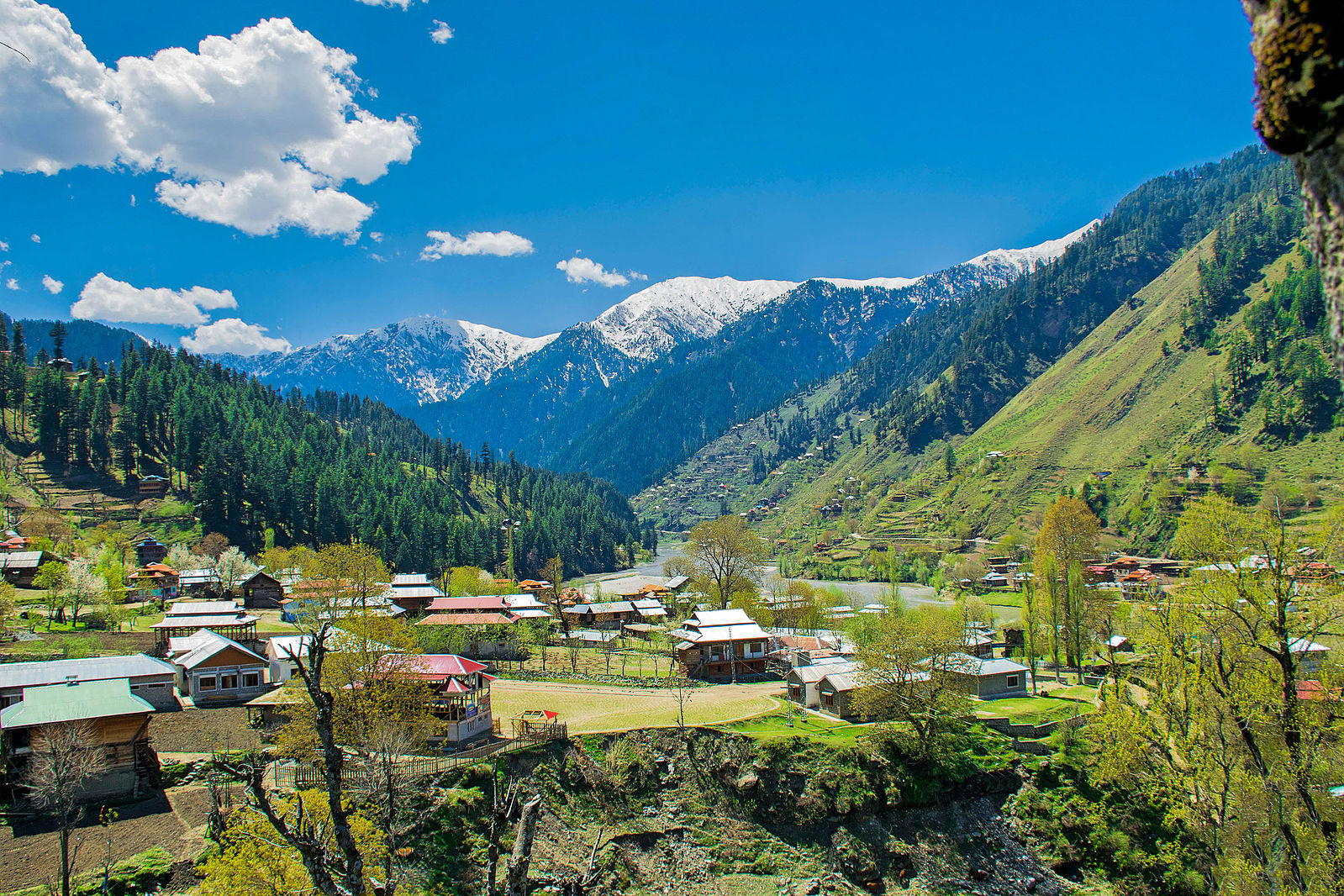
“If there is a paradise on earth, it is here, it is here, it is here.” So reads a couplet by the famous Persian-language Indian poet Amir Kusrau. The verse is often said to refer to Kashmir, long regarded as the most beautiful region on the subcontinent, a favourite of Mughal emperors, so much so that Emperor Jahangir, when asked, on his deathbed, as to his most cherished memory, is said to have replied: “Kashmir. The rest is worthless.”
There is little doubt that, for those lucky enough to travel there, Kashmir is a land blessed with great natural beauty: flower-filled valleys, crystal clear rivers, and mist-shrouded hills. The region is famed for walnuts and saffron, for the hand-knotted carpets and silk Pashmina shawls found in its markets, for icy blue lakes and picturesque houseboats, for the legendary ‘wazwan’, the thirty-six course meal served to visiting kings, and the Hazratbal Shrine, believed to house strands of the Prophet Mohammed’s hair.
Today, Kashmir’s tortured political status is common knowledge. The state is made up of multiple administrations: Jammu and Kashmir lies under Indian control, Azad Kashmir is Pakistan-administered, and the Aksai Chin region is governed by China.
What is not so well known is Kashmir’s fabulous past.
Legend has it that in 326 BCE, when Alexander the Great reached the limits of his expedition to conquer the known world, and there engaged in battle with the Indian king Porus, it was to the Kashmiri king Abisares that Porus turned for reinforcements. (Not that it helped him. Alexander won the Battle of Hydaspes, only to then be forced to turn back for home by his war-weary troops.)
The arrival of Islam into Kashmir marked a watershed moment.
The Turkic-Mongol warlord Dulacha raided Kashmir and ousted the long ruling Hindu Lohara dynasty in AD 1320. Two decades later, a Muslim minister named Shah Mir established lasting Muslim rule in Kashmir – Mir founded a dynasty that would stretch from 1339 until 1561.
With the foundation of this “sultanate”, Kashmir began to attract Muslim missionaries, sufis, and scholars from across the Islamic world. In due course Islam became the dominant religion of the valley, influencing customs, habits, dress, language – Sanskrit all but vanished during this period – and culture.
The advent of India’s Mughal emperors: Akbar the Great, his son Jahangir, and his grandson Shah Jahan – gave Kashmir prominence in the new Islamic empire. The Mughal reign transformed Kashmir once again, with the building of numerous celebrated palaces, mosques, and gardens, none more famous than the Shalimar Bagh, lying just north of Dal Lake in Srinagar. (The bagh – or garden – was built by the Emperor Jahangir for his wife Nur Jahan.)
Following four centuries of Muslim rule, Kashmir fell to Sikh control, with the arrival of the one-eyed Maharaja Ranjit Singh of Punjab (for the curious: he’d lost his eye to smallpox). The Sikh reign was marked by a series of anti-Muslim decrees, and draconian taxes.
Sikh rule in the region was eventually succeeded by a Hindu nobleman at Ranjit Singh’s court named Gulab Singh. Singh became the first maharaja of the princely state of Jammu and Kashmir after war broke out between the British and the Sikh Empire in 1845. During that first Anglo-Sikh War, Gulab Singh sided with the British and was rewarded with control over the region.
During his reign Gulab Singh favoured a small but influential Hindu minority, the Kashmiri pandits (Hindus of the highest Brahmin caste, who, many years later, in 1990, would be forced to exodus the region en masse), leading to conflict with the majority Muslim population of the region.
Things came to a head – and planted the seed for Kashmir’s modern woes – with Partition in 1947.
Gulab Singh’s grandson, Hari Singh, was the reigning ruler at the time. Rulers of Princely States (as Kashmir was then designated) were encouraged by the British to accede their states to either India or Pakistan. At the time, Kashmir’s population was three quarters Muslim, many of whom wished to side with Pakistan. Hari Singh, a Hindu, was not convinced. To postpone a decision, Hari Singh signed a “standstill agreement” with Pakistan.
However, following a guerrilla campaign of insurgents arriving from Pakistan in an attempt to force Hari Singh’s hand, the maharajah turned to the Indian government for help. The price? Accession of the state to the new republic.
Hari Singh duly offered accession; India duly accepted.
A furious Pakistan responded by arguing that Hari Singh could not legally sign such an accession given the standstill agreement he had already agreed to.
And from that day to this, the two sides have quarrelled over the status of the region, including several wars, a long-running separatist insurgency, draconian local policing, regular military skirmishes along the so-called ‘Line of Control’, and lasting economic, social and political harm inflicted upon the residents of the region.
Just over a year ago, things changed once again.
India’s Narendra Modi-led government revoked Article 370 of the Indian Constitution – the clause that had given the state of Kashmir a degree of autonomy and many special privileges in its relationship with the country as a whole (including its own constitution and the right to bar Indians outside of the state from settling there). In essence, the Indian government has enacted its belief that Jammu and Kashmir is a part of India and should not be treated differently to any other state in the country.
As the only Muslim-majority region to join India at Partition, the action has caused uproar in Kashmir, where mistrust of the government’s intentions is high. The government argues that by putting Kashmir on an equal footing with the rest of the country it will encourage investment into the region. Locals believe this is a way for the ethnic makeup of the region to gradually be altered.
One can only hope that the move is a positive one for the average Kashmiri, and that, in due course, the region – with all its natural beauty – once again becomes accessible to outside visitors.
It isn’t only the Mughal emperors who would wish to appreciate India’s ‘paradise on earth’.
This article is one of a series of 50 that I will be publishing on my website. Together these pieces explore the history and culture of India from her most ancient civilisations to the nation’s ambitious space programme. You can read all 50 pieces here.
All 50 articles will be collected into a digital book and published in due course. To receive a FREE copy of the book, simply register for my newsletter here. The newsletter goes out every three months and contains updates on book releases, articles, competitions, giveaways, and lots of other interesting stuff.
My latest novel, Midnight at Malabar House, is set in India, in the 1950s, and introduces us to India’s first female police detective, Persis Wadia, as she investigates the murder of a top British diplomat in Bombay. Available from bookshops big and small and online, including here.
This article is one of a series of 50. Together they explore the history and culture of India from her most ancient civilisations to the nation’s ambitious space programme. All 50 articles will be collected into a digital book and published in due course. To receive a FREE copy of the book, simply register for my newsletter here.
Nine hundred and thirty-one. That’s the number of murders attributed to an Indian named Behram Jemedar, a senior member of India’s notorious Thuggee cult. Because of his propensity for killing he is today regarded as one of the world’s most prolific serial killers. His tally is, nevertheless, a drop in the ocean when compared with the estimated two million that the Thugs collectively murdered over a period of six centuries on the subcontinent.
Who were these mass murderers? Why did they kill? And what happened to them?
The word Thuggee means “concealment”, and, in essence, this was the secret to the success of this gang of professional assassins and thieves. The Thugs were bound by something stronger than greed or malice; they were united through their devotion to the Hindu Goddess Kali, in whose name they carried out their killings. This fanatical cult operated in India from the 1200s to the late 1800s, organising themselves into an incredibly efficient machine that operated with a high degree of teamwork and co-ordination.
The Thugs’ modus operandi was to join groups of travellers and gain their trust before surprising them in the night and (typically) strangling them with a handkerchief or noose. This quick and quiet method left no blood and required no complicated arsenal. To add insult to injury, the victim would then be divested of his or her possessions and carefully buried.
Thugs travelled in packs, with each participant assigned a role – one man was responsible for luring the unsuspecting victim into conversation, another acted as a lookout, and yet another might take on the role of killer. The gang used a secret language and signs; in this way members could recognize each other across the country. They were bound by a strict set of rules: for instance, they would not steal a person’s property unless the killing had been carried out with the proper observance of ritual. They would not kill the sick – considering them an unworthy sacrifice – or women, as they were deemed to be incarnations of Kali.
Membership to the fraternity was passed down from father to son. Others trained with a guru. Sometimes the children of victims were taken and groomed, inducted into their murderous future calling at an early age.
The cult came to widespread recognition with the publication of Confessions of a Thug, a fictionalised account of their activities by Philip Meadows Taylor. The book, released in 1839, became a bestselling work of Empire – even Queen Victoria was said to be riveted!
The Thugs’ silent reign of terror was ultimately brought to an end by the British.
During the 1830s, the cult was targeted for eradication by the Governor-General of India, William Bentinck, who delegated the task to his chief captain, William Henry Sleeman.
In 1835, Sleeman captured a Thug who led him to a grave containing almost a hundred bodies. The man quickly turned witness, offering up the names of many of his peers, allowing Sleeman to begin a pogrom to eradicate the menace. As a result of his efforts, within a few short years, more than 1400 Thugs were hanged or transported for life, including Behram Jemedar. In 1839, Sleeman published a government report and several books about his efforts including the colourfully entitled Report on the Depredations Committed by the Thug Gangs of Upper and Central India.
The Thugs vanished from Indian society, but rumours lingered of small operational units surviving well into the twentieth century. These rumours clearly travelled as far as Hollywood – back in the 1980s the Thugs made a notable appearance in Indiana Jones and the Temple of Doom.
Today, their terrible legacy lives on in the word ‘thug’ which has found life not only as a way to refer to aggressive young criminals and antisocial teenagers but also as a dubious moniker used in the world of hip hop.
No doubt Behram would be pleased.
This article is one of a series of 50 that I will be publishing on my website. Together these pieces explore the history and culture of India from her most ancient civilisations to the nation’s ambitious space programme. You can read all 50 pieces here.
All 50 articles will be collected into a digital book and published in due course. To receive a FREE copy of the book, simply register for my newsletter here. The newsletter goes out every three months and contains updates on book releases, articles, competitions, giveaways, and lots of other interesting stuff.
My latest novel, Midnight at Malabar House, is set in India, in the 1950s, and introduces us to India’s first female police detective, Persis Wadia, as she investigates the murder of a top British diplomat in Bombay. Available from bookshops big and small and online, including here.
This article is one of a series of 50. Together they explore the history and culture of India from her most ancient civilisations to the nation’s ambitious space programme. All 50 articles will be collected into a digital book and published in due course. To receive a FREE copy of the book, simply register for my newsletter here.
Salman Rushdie’s fifth novel, The Moor’s Last Sigh, is set, in part, in the southern Indian coastal city of Cochin. It traces four generations of the Zogoiby family, a dynasty of Cochinese spice merchants and crime lords, of Jewish extraction. The novel was well received, shortlisted for the Man Booker prize, and one of the few literary depictions of the Jewish community in India, a community that today stands on the brink of extinction.
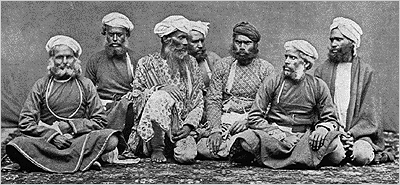
The Jews have a long history on the subcontinent. Arriving from different parts of the world, they settled in various distinct communities, mainly in the south of India . Most prominent among these are the Malabari Jews of Cochin– who claim to have made their way to the subcontinent with traders representing King Solomon – and the Paradesi Jews – who arrived during the 16th century following the expulsion of Jews from Spain and Portugal, fleeing persecution and pogroms in their homelands.
For the Cochin Jews it is a matter of pride that they are the oldest Jewish community in India. The historical narrative maintained by the community’s elders tells a story of traders arriving from Judea at Cranganore, an ancient port near Cochin (modern day Kochi in the south Indian state of Kerala), in 562 BC. Five centuries later, they were followed by exiles from Israel after the destruction of the Second Temple in the year 70 AD.
The Cochin Jews quickly established a close relationship with local Indian rulers, convincing them to give their blessing for the newcomers to live as per the tenets of their creed, including the right to build synagogues. Indeed, many Jewish refugees were offered land and materials by local rulers to aid in the construction of these temples.
The Cochin Jews became known for working in the spice and pepper trade. Over time their language and customs evolved to mirror the local environment; they dressed as Indians, ate the local food, and spoke Malayalam. Nevertheless, visitors to the region noted their devotion to their faith and the strict observance of Jewish traditions, including the teaching and passing on of the Hebrew language.
For centuries, the Jews of Cochin prospered, but in the 1500s they were attacked by Muslims for control of the lucrative pepper trade. Many were driven southwards to seek the protection of the Cochin royal family.
It is estimated that India’s Jewish population peaked at around 20,000 in the mid-1940s, and began to rapidly decline in the 1950s when most of the Indian Jewish population migrated to Israel. Today, a handful of Jewish families remain in Cochin, barely hanging onto their ancient traditions.The main visitors to synagogues are now tourists rather than devout worshippers.
The legacy the Jews of India leave in their wake is that of a community that managed to successfully weave itself into the fabric of India. There has been very little documented evidence of anti-Semitism on the subcontinent, something that sets this unique band of Jewish settlers apart from their co-religionists elsewhere in the world.
This article is one of a series of 50 that I will be publishing on my website. Together these pieces explore the history and culture of India from her most ancient civilisations to the nation’s ambitious space programme. You can read all 50 pieces here.
All 50 articles will be collected into a digital book and published in due course. To receive a FREE copy of the book, simply register for my newsletter here. The newsletter goes out every three months and contains updates on book releases, articles, competitions, giveaways, and lots of other interesting stuff.
My latest novel, Midnight at Malabar House, is set in India, in the 1950s, and introduces us to India’s first female police detective, Persis Wadia, as she investigates the murder of a top British diplomat in Bombay. Available from bookshops big and small and online, including here.
This article is one of a series of 50. Together they explore the history and culture of India from her most ancient civilisations to the nation’s ambitious space programme. All 50 articles will be collected into a digital book and published in due course. To receive a FREE copy of the book, simply register for my newsletter here.
The Mughal emperors of India number among the wealthiest and most extravagant monarchs in history. Their legendary decadence and penchant for wild spending has left behind a rich legacy of historical treasures.
Descended from the Turco-Mongol dynasties of Timur and Genghis Khan, the Mughals ruled the subcontinent from the early 1500s to the late 1850s, three centuries of all-but unchallenged dominance – until the advent of the British Raj. Invading from Afghanistan in the north, they brought Islam to India, expressed as Islamic poetry, gardens and architecture, the most famous example of which is, of course, the Taj Mahal.
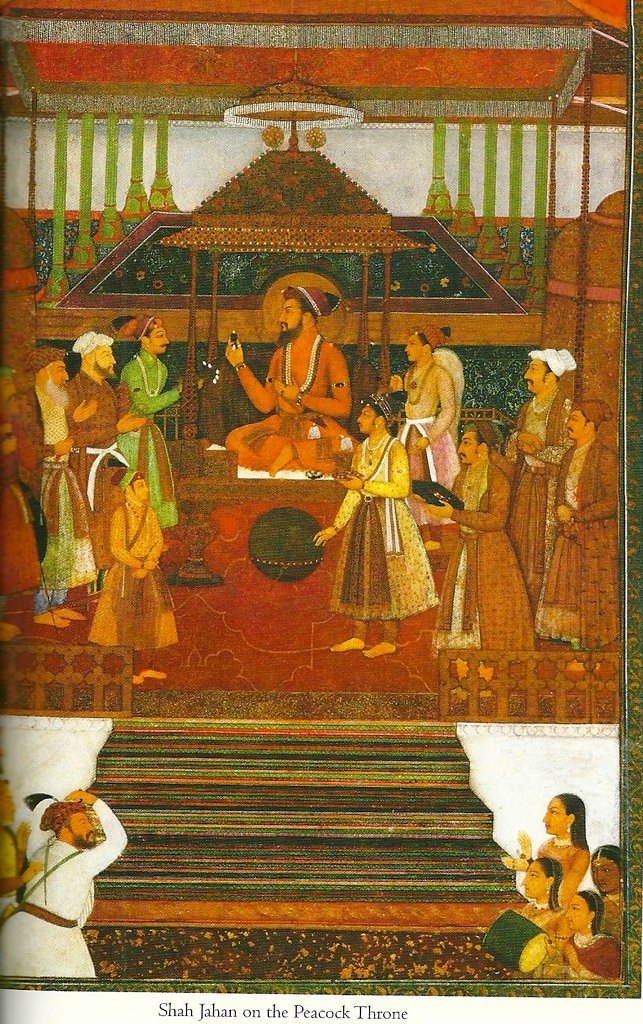
The visionary behind the Taj, Emperor Shah Jahan, has long been serenaded by history for his magnificent architectural marker. What is less well known is that he also commissioned the Peacock Throne that served as the (literal) seat for Mughal emperors for over a century. The throne is regarded as both a great work of art and a testament to the skill of the master craftsmen of the time.
Shah Jahan ruled during what is considered the Golden Age of the Mughal Empire – at one point it was estimated that the empire generated 25% of world GDP.Having established his capital at Shahjahanabad, in the ornately decorated Red Fort, Shah Jahan held daily court, giving audiences and receiving petitioners. The court was designed to be a mirror image of paradise on Earth, the beating heart of the empire. To grace his courtroom, Shah Jahan commissioned a throne to rival the legendary Throne of Solomon, a jewel-encrusted gold seat to be built on a pedestal, so that he might be raised above his courtiers.
The throne took seven years to complete, a masterpiece of Mughal workmanship, at an eye-watering cost – it is estimated that it cost twice as much as the construction of the Taj Mahal. Among the hundreds of rubies, emeralds, pearls, diamonds, and other jewels embedded in the Peacock Throne was the famed Koh-i-Noor diamond, once the largest in the world, later brought to England and now resident in the Tower of London as part of the British Crown Jewels.
The throne was ascended by silver steps and stood on golden feet set with jewels. It was backed by representations of two fanned peacocks’ tails – the peacocks from which it derives its name – gilded, enamelled, and inset with diamonds, rubies, and other stones.Muhammad Qudsi, the emperor’s favourite poet, was chosen to compose twenty verses and these too were inscribed on the seat in emerald and green enamel.
The Peacock Throne was inaugurated in an elaborate ceremony on 22 March 1635, the seventh anniversary of Shah Jahan’s accession. Shah Jahan was succeeded by his son Aurangazeb who, in turn, was followed by a succession of Mughal emperors, all ruling from the Peacock Throne, until 1739, when Nader Shah of Persia sacked Delhi and stole the magnificent seat.
Eight years later, Nader Shah’s bodyguards assassinated him, and Persia descended into chaos.
Historians believe that the Peacock Throne was then dismantled and stripped for its precious jewels, but legends continue to circulate of the throne being smuggled away to a secret hiding place.
If it does exist and is ever found it will mark one of the greatest historical finds of all.
This article is one of a series of 50 that I will be publishing on my website. Together these pieces explore the history and culture of India from her most ancient civilisations to the nation’s ambitious space programme. You can read all 50 pieces here.
All 50 articles will be collected into a digital book and published in due course. To receive a FREE copy of the book, simply register for my newsletter here. The newsletter goes out every three months and contains updates on book releases, articles, competitions, giveaways, and lots of other interesting stuff.
My latest novel, Midnight at Malabar House, is set in India, in the 1950s, and introduces us to India’s first female police detective, Persis Wadia, as she investigates the murder of a top British diplomat in Bombay. Available from bookshops big and small and online, including here.
This article is one of a series of 50. Together they explore the history and culture of India from her most ancient civilisations to the nation’s ambitious space programme. All 50 articles will be collected into a digital book and published in due course. To receive a FREE copy of the book, simply register for my newsletter here.
Marco Polo needs little introduction. Remembered today as one of history’s great explorers, the Venetian trader travelled to Asia in the 13th century, spending more than two decades away from his native Italy, and returning with a chronicle of such incredible sights and observations that his name remains synonymous with European travel to the Orient.
Polo trained as a merchant, learning the trade from his father, Niccolo, and his uncle, Maffeo, themselves ambitious travellers who had previously set up trading posts in Constantinople, Crimea, and the western part of the Mongolian Empire. Here they met Kublai Khan, grandson of Genghis Khan, and ruler of the Mongols.
In 1271, the three men embarked on an epic journey to Asia, travelling largely along the Silk Road until they reached Cathay – modern day China – where they were received by the royal court of Kublai Khan. Khan was so impressed by the younger Polo’s intelligence and humility that he decided to appoint Marco to serve as his emissary to India and Burma.
Polo soon found himself sent on many diplomatic missions throughout the Great Khan’s empire, including to India, where he visited the southern tip of the subcontinent – specifically, modern day Tamil Nadu and Kerala – between 1292 and 1294 – arriving on the Coromandel Coast in a merchant ship with some three hundred men at his disposal.
He made landfall at Tanjore, and entered the kingdom of the Tamil Pandyas.
Here Polo began his documentation of the rich social fabric of India: “The climate is so hot that all men and women wear nothing but a loincloth, including the king – except his is studded with rubies, sapphires, emeralds and other gems.”
He recorded numerous phenomena that astonished him. For instance, he was perplexed by the Indian addiction to the betel nut leaf. “All the people of this city, as well as of the rest of India, have a custom of perpetually keeping in the mouth a certain leaf… continually chewing it and spitting out the saliva that it excites… If anyone desires to offer a gross insult to another, when he meets him, he spits this juice in his face.”
Another aspect of Indian life that excited his interest was religion. He was particularly taken with Jain monks: “They would not kill an animal on any account, not even a fly, or a flea, or a louse, or anything in fact that has life; for they say these all have souls, and it would be a sin to do so.”
Polo documented his travels in The Travels of Marco Polo, a book that did much to reveal to Europeans the mysteries of the Orient. Such were his descriptions of the enormous wealth that he saw in the Mongol Empire and in India that he was accused of making things up!
Although the Polos weren’t the first Europeans to visit China, Marco Polo was the first European to publish a detailed account of it. His book became an important document for future explorers, including the likes of Christopher Columbus and Vasco da Gama who later made his way to Goa.
Having returned to Venice, Polo never ventured far afield again. Legend has it that, on his deathbed, he said: “I have only told half of what I saw.”
This article is one of a series of 50 that I will be publishing on my website. Together these pieces explore the history and culture of India from her most ancient civilisations to the nation’s ambitious space programme. You can read all 50 pieces here.
All 50 articles will be collected into a digital book and published in due course. To receive a FREE copy of the book, simply register for my newsletter here. The newsletter goes out every three months and contains updates on book releases, articles, competitions, giveaways, and lots of other interesting stuff.
My latest novel, Midnight at Malabar House, is set in India, in the 1950s, and introduces us to India’s first female police detective, Persis Wadia, as she investigates the murder of a top British diplomat in Bombay. Available from bookshops big and small and online, including here.
This article is one of a series of 50. Together they explore the history and culture of India from her most ancient civilisations to the nation’s ambitious space programme. All 50 articles will be collected into a digital book and published in due course. To receive a FREE copy of the book, simply register for my newsletter here.
On January 26th 1950, the day that India officially became a republic, the new nation adopted an “Emblem of India” – a graphic representation of four lions standing back to back on an elaborately carved base. This emblem was derived from the Lion Capital of Ashoka, a sculpture originally placed on top of a pillar at a Buddhist site at Sarnath by the Emperor Ashoka in around 250 BCE. At one time, there were numerous such pillars dotted around the subcontinent bearing the so-called Edicts of Ashoka.
Who was Ashoka? Why did he leave such a mark on the subcontinent?
The grandson of Indian emperor Chandragupta Maurya, founder of the Maurya Dynasty; Ashoka ruled from 268 to 232 BCE.
Upon ascending the throne, the young king quickly distinguished himself with his military prowess and a notable penchant for cruelty, particularly towards criminals. (A later Chinese visitor to India reported on a handed-down tale of a prison established by the former emperor known as “Ashoka’s hell”. Those unlucky enough to be sent there were routinely tortured and had no hope of leaving the place alive.)
Ashoka’s moment of revelation occurred following a destructive war against the state of Kalinga – modern day Odisha, on India’s eastern coast. Despite emerging as the victor in that conflict, the price of victory horrified the young king. Apocryphal stories tell of him walking through a battlefield strewn with a hundred thousand dead, facing up to the bloodthirsty necessities of empire-building.
Soon afterwards, Ashoka converted to Buddhism, going on to become a tireless proselytiser for the faith. In time, he would despatch Buddhist monks to all corners of the subcontinent with his message of peace. Guided by the tenets of his new religion, he constructed thousands of monasteries and stupas, and pursued a programme of social welfare including the establishment of medical facilities – for both humans and animals, the digging of wells, and the mass plantation of trees. He began to issue a succession of now-famed edicts, instructing his officials to carve them on rocks and pillars throughout his kingdom. In these ‘rock edicts’, Ashoka talks about religious tolerance, charity for the poor, obedience to one’s parents, and respect for elders.
Ashoka ruled for over 30 years. At its zenith, his empire extended from present-day Afghanistan in the west to modern Bangladesh in the east. His inscriptions are a testament to the fact that he spent much of his reign in the propagation of the Buddhist concept of “dharma” – the achievement of ‘rightness’ or ‘justice’. Under him the subcontinent thrived, maintainingan estimated population of 30 million, higher than any of his contemporary Hellenistic kingdoms. Following his death, the Mauryan Dynasty came to a swift end and Ashoka’s vast empire crumbled into ruin. Yet his name – which means “without sorrow” – lives on. It is often remarked that he did for Buddhism in India what Constantine did for Christianity in Europe.
The great author H.G. Wells, wrote of him: “Amidst the tens of thousands of names of monarchs that crowd the columns of history, their majesties and graciousnesses and serenities and royal highnesses and the like, the name of Ashoka shines, and shines, almost alone, a star.”
This article is one of a series of 50 that I will be publishing on my website. Together these pieces explore the history and culture of India from her most ancient civilisations to the nation’s ambitious space programme. You can read all 50 pieces here.
All 50 articles will be collected into a digital book and published in due course. To receive a FREE copy of the book, simply register for my newsletter here. The newsletter goes out every three months and contains updates on book releases, articles, competitions, giveaways, and lots of other interesting stuff.
My latest novel, Midnight at Malabar House, is set in India, in the 1950s, and introduces us to India’s first female police detective, Persis Wadia, as she investigates the murder of a top British diplomat in Bombay. Available from bookshops big and small and online, including here.
This article is one of a series of 50. Together they explore the history and culture of India from her most ancient civilisations to the nation’s ambitious space programme. All 50 articles will be collected into a digital book and published in due course. To receive a FREE copy of the book, simply register for my newsletter here.
The Indus river begins high up in the Himalayan mountains and flows nearly 3,000 kilometres to the Arabian Sea. In 1826, a British traveller in India stumbled across a series of mysterious brick mounds in the valley carved out by the river as it flows downstream. His name was Charles Masson and he described his find in his publication: Narrative of Various Journeys in Balochistan, Afghanistan, and the Punjab.
Thirty years later, in 1856, engineers building a railway in the region found more bricks. Unbeknownst to them, these bricks were the first evidence of the lost Indus city of Harappa, one of the twin capitals of what would become known as the Indus Valley civilisation.
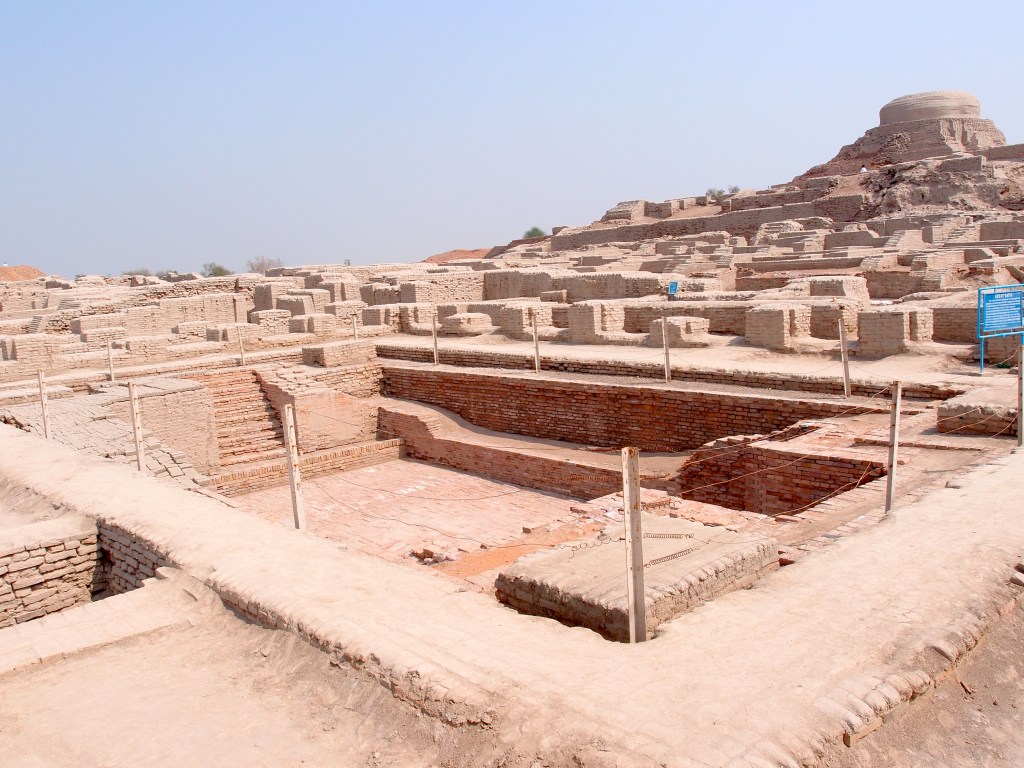
It wasn’t until the 1920s that archaeologists finally began to excavate the sites of Harappa and Mohenjo-daro. In so doing, they uncovered the remains of a civilisation that had settled the Indus Valley at least five millennia earlier.
Image by By Saqib Qayyum – Own work, Creative Commons 3.0
Today, over one thousand settlements have been identified in the region (with over one hundred now excavated), revealing asophisticated and technologically adept urban culture: city streets laid out in grid patterns, sewage and drainage systems more advanced than any found in contemporary sites in the Middle East, and massive citadels larger than most Mesopotamian ziggurats. The people of the Indus Valley developed pottery, metal working and a rudimentary written script – sadly, yet to be deciphered. They left behind few artefacts. The most telling are several small seals, made of steatite, depicting a variety of animals, both real—such as elephants, tigers, and antelopes—and mythological. Examples of Indus stone sculpture have also been found, representing humans or gods. The people of the Indus were among the first to develop a system of uniform weights and measures. They were primarily farmers, but trade flourished.
By every measure this was a highly organised and technologically advanced society.
This ancestral Indian civilisation emerged on the subcontinent in the western margins of the Indus river basin around 3300 BCE, rising to a peak around 2000 BCE. Yet, some three centuries later,most Indus cities had been abandoned and the empire had fallen into ruin.
How did this apparently peaceful, well-organised civilisation collapse in such a relatively short span? Theories abound.
Some speculate that the cities became overcrowded leading to the spread of disease. In 1953, British archaeologist, Sir Mortimer Wheeler, proposed that the decline of the Indus Valley Civilization was caused by the invasion of an Indo-European tribe from Central Asia called the “Aryans”. As evidence, he cited a group of thirty-seven skeletons found in various parts of Mohenjo-daro, and passages in ancient Hindu poems called the Rig Veda (dated around 1500 BC) that describe northern invaders conquering Indus Valley cities. Today, many scholars believe that the collapse was triggered by drought and a decline in trade with Egypt and Mesopotamia. It has also been suggested that deforestation, floods, or changes in the course of the Indus river may have been contributing factors.
The Indus Valley peoples did not disappear overnight, and many elements that characterised their societies can be found in later cultures. In effect, this ancient civilisation provided the foundation for the long evolution of the Indian culture that we see today. These were the very first Indians.
The Indus Valley Civilisation lay forgotten and undiscovered for thousands of years. Today, it is recognised for its many achievements. Mohenjo-daro was, at its time, probably the greatest city in the world – 4,500 years ago, as many as thirty-five thousand people lived there. The name India is itself derived from Indus, which originates from the Old Persian word Hindu. The latter term stems from the Sanskrit word Sindhu, which was the historical local appellation for the Indus River. Even the ancient Greeks referred to the Indians as Indoi which translates as “The people of the Indus.”
This article is one of a series of 50 that I will be publishing on my website. Together these pieces explore the history and culture of India from her most ancient civilisations to the nation’s ambitious space programme. You can read all 50 pieces here.
All 50 articles will be collected into a digital book and published in due course. To receive a FREE copy of the book, simply register for my newsletter here. The newsletter goes out every three months and contains updates on book releases, articles, competitions, giveaways, and lots of other interesting stuff.
My latest novel, Midnight at Malabar House, is set in India, in the 1950s, and introduces us to India’s first female police detective, Persis Wadia, as she investigates the murder of a top British diplomat in Bombay. Available from bookshops big and small and online, including here.
I read a lot of books, across a wide range of genres. These are my favourites from 2020 – one for each of the 12 days of Christmas. A mixture of crime, literary, non-fiction, and contemporary novels. Something for everyone!
WHERE THE CRAWDADS SING by Delia Owens
Undoubtedly, my read of the year. The New York Times calls this “At once a murder mystery, a coming-of-age narrative and a celebration of nature.” It’s a well written story about a girl abandoned by her family in a marshy outpost of a North Carolina town in the 1950s. As she grows to adulthood – wild, intelligent, lonely – she interacts with the townsfolk in different ways, some pleasant, mostly not so. Most look down on her as ‘marsh trash’. The man who does take an interest, the former high school quarterback and town lothario, later ends up murdered. This is a contemporary novel that happens to include a crime. I found it a wonderful read, with terrific descriptions of the marsh and its wildlife, and a compelling mystery that takes centre-stage in the third act. There’s a reason the book has already sold 8 million copies around the world.
THE SYMPATHIZER by Viet Thanh Nguyen
This book won the Pulitzer Prize and a hatful of other literary awards and you can see why. A satirical masterpiece, written with verve, flair, and extraordinary skill, the novel follows a Vietnamese double-agent forced to flee Saigon at the end of the Vietnam War, only to discover that life in 1970s America is not quite what he has been led to believe. The book mercilessly slaughters both American and Vietnamese cultural icons, exposing the hypocrisy and lies that characterise that turbulent time in the history of these two nations. A landmark novel and a recommend for those who enjoy wicked historical satire.
PRAGUE FATALE by Philip Kerr
I am a recent convert to the Germany-set Bernie Gunther crime novels. This one takes place in 1942, as Nazi ideology makes its jackboots felt across the country. Gunther is brilliantly drawn, a cynical, hardboiled detective, part of the German machine, morally compromised, yet at the same time contemptuous of its hateful rhetoric and actions. In Prague Fatale he is coerced into acting as protector for one of the most evil of all Nazis: Reinhard Heydrich, a principal architect of the Holocaust. Murder ensues at a closed base for German officers in Prague and Bernie must find the culprit.
QUEENIE by Candice Carty-Williams
This hugely successful debut won book of the year at the British Book of the Year Awards. Full of wit, contemporary humour, and a no holds barred attitude that infuses every page, I found this an exhilarating read. Queenie is a wonderfully drawn character, a mass of contradictions, at once loud, vulnerable, committed, flaky, tender, ridiculous, and insightful. The world through Queenie’s eyes is well worth a look.
DOMINION by Tom Holland
This non-fiction work by noted historian Holland applies itself to the question of how Christianity came about and how it then grew to become so influential. I found this a fascinating read, full of intriguing historical anecdotes, vividly depicted characters, and a narrative that brought to life in new and interesting ways some of the great stories of Christianity that many of us have imbibed. All told in Holland’s fluid, engaging and often provocative style.
THE CURATOR by M.W. Craven
The Curator is the latest entry in this dark crime series, powered by its two contrasting but perfectly cast police protagonists: the burly no nonsense supergrouch Washington Poe, and the genius but socially awkward young Tilly Bradshaw. On the trail of another serial killer, they are confronted by a murderous psychopath with a penchant for leaving body parts in odd places – together with a strange clue. The book won multiple awards this year and it is easy to see why.
THE SECOND SLEEP by Robert Harris
Harris has been one of my favourite authors ever since his brilliant debut Fatherland, a crime novel set in an alternate future where Hitler survived and the Third Reich persisted. Since then he has become a household name. In The Second Sleep he again excels, both in fashioning a gripping plot that unwinds slowly and the measured quality of his writing. It is difficult to say too much without giving essential plot elements/twists away, but the book begins in 1468 with a young monk arriving in a small English village to investigate the death of a priest. It soon turns out the priest in question may have been flirting with heresy. Be warned: this isn’t really a crime novel.
THE CACTUS by Sarah Hayward
The book follows a 45-year-old single woman with a prickly persona and a unique outlook on life. She becomes embroiled in a legal battle with her brother over her mother’s will whilst trying to manage an unexpected pregnancy. The protagonist reminds me of another quirky character – Eleanor Oliphant – star of the recent bestseller Eleanor Oliphant is Completely Fine. If you enjoyed that you’ll probably enjoy this, though there are perhaps fewer outright laughs here.
DEATH IN THE EAST by Abir Mukherjee
The fourth outing in the captain Sam Wyndham and Surrender ‘Surrender-Not’ Banerjee series sees Sam detoxing from his opium addiction in an ashram in the north-eastern state of Assam. The narrative alternates between 1922 India and 1905 London where a young Sam tracks the killer of an old flame. Seventeen years later a ghost from that past crosses his path in Assam. Mukherjee not only steeps us in the atmosphere of the Raj but also recreates a teeming early-nineteenth-century London, exploring issues of migration and xenophobia, matters all too relevant to our current moment.
HUMANS by Matt Haig
An intriguing contemporary read. An alien comes to Earth and takes over the body of an eminent British professor who has just made a mathematical discovery that will, apparently, have dire consequences for the cosmos. Our alien protagonist is tasked to erase any sign of the discovery and anyone who may know of it. But the more time he spends with these strange creatures called ‘humans’ the more he comes to understand what makes them so unique… Haig writes in a fluid way and keeps the pages turning with a blend of wit and quirky happenstance. The third act may be a little too preachy for some, but overall I found the book enjoyable.
FORCE OF NATURE by Jane Harper
I loved Harper’s debut The Dry, which became a megaseller and won numerous crime fiction awards around the world. This book again features Australian cop Aaron Falk, this time on the trail of a woman who goes missing in the Aussie wilderness after trekking out with four other women as part of a corporate bonding exercise. Is she alive? If not, who killed her? It was always going to be difficult for Harper to recreate the brilliance of her debut, but this book is pacey, well plotted, nicely written, and keeps the pages turning.
THE GENERAL’S DAUGHTER by Nelson DeMille
An oldie but a goodie. For those of you who have seen the film the plot won’t come as a surprise. A brilliant young female officer – daughter of a general, no less – is found naked, strangled, and staked out on a rifle range at a southern US military base. Army CID officer Paul Brenner, accompanied by rape specialist Cynthia Sunhill, is called in to investigate. Nothing, of course, is quite as it seems. Nelson DeMille is a giant of the thriller genre, and a former army officer. His prose is sharp, his plotting meticulous, and he brings Brenner to life with a dry, laconic style that really appealed to me.
And if you’d like to keep up to date with what I’m up to next, I send out an email newsletter every three months which contains updates on book releases, articles, competitions, giveaways, and lots of other interesting stuff. If intrigued, registering takes a few seconds here.
My latest novel, Midnight at Malabar House, is set in India, in the 1950s, and introduces us to India’s first female police detective, Persis Wadia, as she investigates the murder of a top British diplomat in Bombay. Available from bookshops big and small and online, including here
In this series of articles I profile 10 great Indian novels…
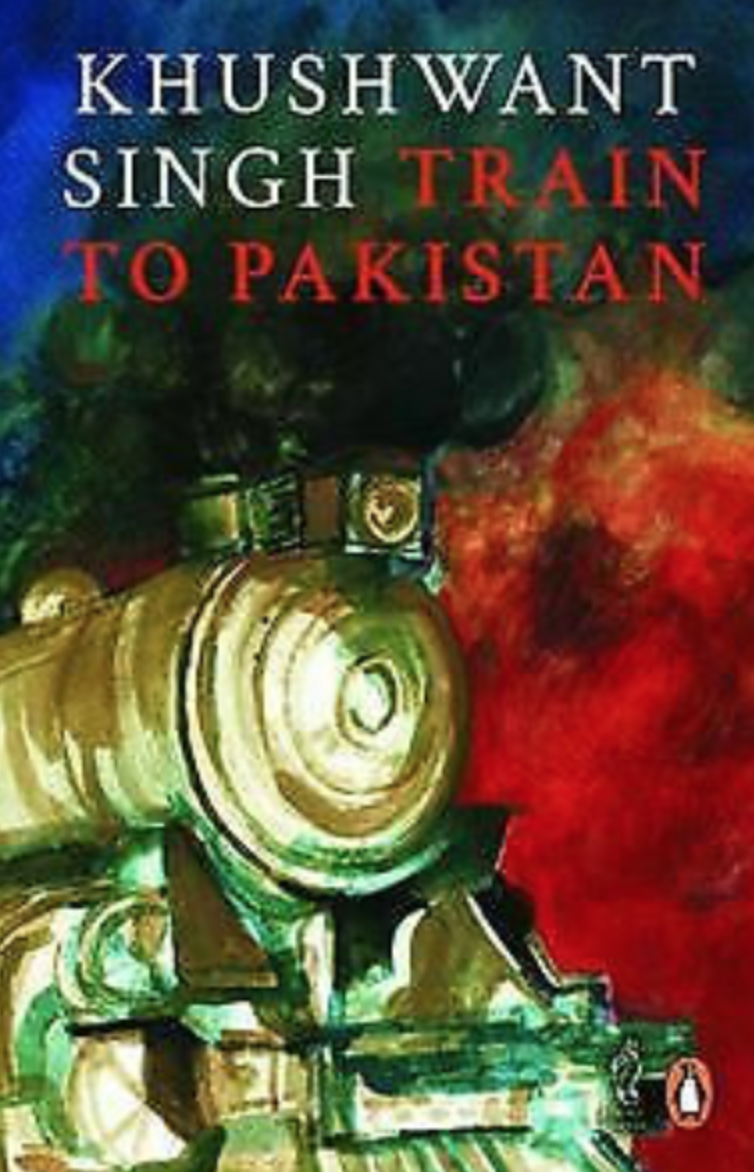
Revered Indian novelist Khushwant Singh’s most famous work was published in 1956 at a time when the wounds of Partition were still raw. Since then it has courted controversy, both in its original form and in several subsequent attempts at bringing it to the screen, only one of which was successful, and that after a protracted battle with the Indian censors.
Train to Pakistan shines a spotlight on one of the most harrowing periods in the subcontinent’s history, when the cataclysmic effects of Partition reverberated throughout communities around the country, setting Muslim against Hindu and Sikh, pitting neighbour against neighbour in an orgy of violence that left over a million dead.
The novel is set in the fictional village of Mano Majra, on the border between Pakistan and India. The village is populated by Muslims and Sikhs, who have lived together peacefully for generations. Singh introduces us to a small cast of characters, most prominently Juggut Singh, a violent scoundrel; Iqbal Singh, a weak-willed social activist newly arrived in the village to proselytise on behalf of his political masters; and Hukkum Chand, a local magistrate.
The villagers of Mano Majra, a close-knit community, are largely uninformed of what is happening around them in the country at large; but when rumours begin to trickle in of atrocities being committed in neighbouring villages the seeds of trouble are sown.
In due course, a train arrives from Pakistan, loaded with corpses. This becomes the catalyst for the local police to force Muslims to leave for Pakistan – ostensibly for their own safety. They are housed in a refugee camp overnight awaiting a train to Pakistan. But then Sikh agitators arrive, demanding that the remaining villagers pick up their swords and come with them to seek vengeance…
What sets Kushwant Singh’s novel above earlier attempts to depict the horror of Partition is his focus on the individual. There is little in the way of political grandstanding. Instead, we see an understanding of human motivations, the murkiness of decisions made when fear, rumour and peer pressure combine, and a moral commentary that deftly infuses the work. This perspective gives the story a harrowing, visceral believability – we are never in any doubt that the horrific events that he depicts are a representation of actual incidents.
The book is relatively short, but all the more powerful because of it, condensing a series of literary gut-punches into less than 200 pages. Singh’s writing style is similarly punchy. He eschews elegy, preferring to offer a clean, precise narrative akin to reportage. His method brings to life villages such as Mano Majra, caught in the eye of the storm during that terrible time. He also makes it clear that the blame for the violence cannot be placed on any one group – all were responsible.
“Muslims said the Hindus had planned and started the killing. According to the Hindus, the Muslims were to blame. The fact is, both sides killed. Both shot and stabbed and speared and clubbed. Both tortured. Both raped.”
This is not a novel for the faint-hearted. Some of the atrocities Singh describes are difficult to stomach. The idea that humans could – and did – do this to one another calls into question everything we believe about ourselves as moral, intelligent, supposedly enlightened creatures. Yet it is precisely this refusal to shy away from the reality of what occurred that makes the novel a landmark in world literature.
Today the work is just as relevant. India and Pakistan continue to rattle sabres at one another, exchanging hostile rhetoric at every opportunity. Kashmir is the issue that, more often than not, sparks political angst and the corresponding civilian unrest. But the seeds of this strife were sown during those short years around 1947 when the country was engulfed in something akin to madness.
No writer has captured that sense of bloody anarchy better than Kushwant Singh in this enduring classic.
If you’d like to keep up to date with what I’m up to next, I send out an email newsletter every three months which contains updates on book releases, articles, competitions, giveaways, and lots of other interesting stuff. If interested, registering takes a few seconds here.
My latest novel, Midnight at Malabar House, is set in India, in the 1950s, and introduces us to India’s first female police detective, Persis Wadia, as she investigates the murder of a top British diplomat in Bombay. Available from bookshops big and small and online, including here
And you can read all 10 Great Indian Novel articles (in due course) on my blog archive here





 Vaseem Khan


.jpg)